Most living rooms have one spot that looks unfinished: the corner by the sofa, the gap next to the TV console, the bare wall between two windows. Tall indoor plants fill that kind of space better than a cluster of small pots, but only when the plant can live on the light that spot really gets. A fiddle-leaf fig that looked perfect in the shop can start dropping leaves soon after it lands in a corner far from the glass.
So start with the light, then pick the plant. Below, floor plants are matched to four common spots, with the pot, the placement and the smaller plants that make a big one look settled.
How to read your living room light before buying tall indoor plants
Light indoors fades much faster than your eyes suggest. Extension horticulturists describe it in three rough zones, and the University of Arizona’s guide to interior plants gives a simple version you can check with a tape measure:
- High light: within about 4 feet of a large south, east or west window.
- Medium light: roughly 4 to 8 feet from those windows, or near a west window that gets no direct sun.
- Low light: more than 8 feet from a window, an inside wall or the middle of the room. A north-facing window often stays in this category even close up.
Winter days are shorter and the sun sits lower, so a spot that felt bright in July can be medium by January. Curtains or a building across the street cut light too.
Measure the height too. Check the ceiling, then picture the plant plus its pot. A 6-foot plant in a 14-inch-tall pot needs well over 7 feet of room, and most of these plants keep growing.
Beside a bright window: fiddle-leaf fig and bird of paradise
The high-light zone is where the two most photographed floor plants belong.
Fiddle-leaf fig, the classic statement tree
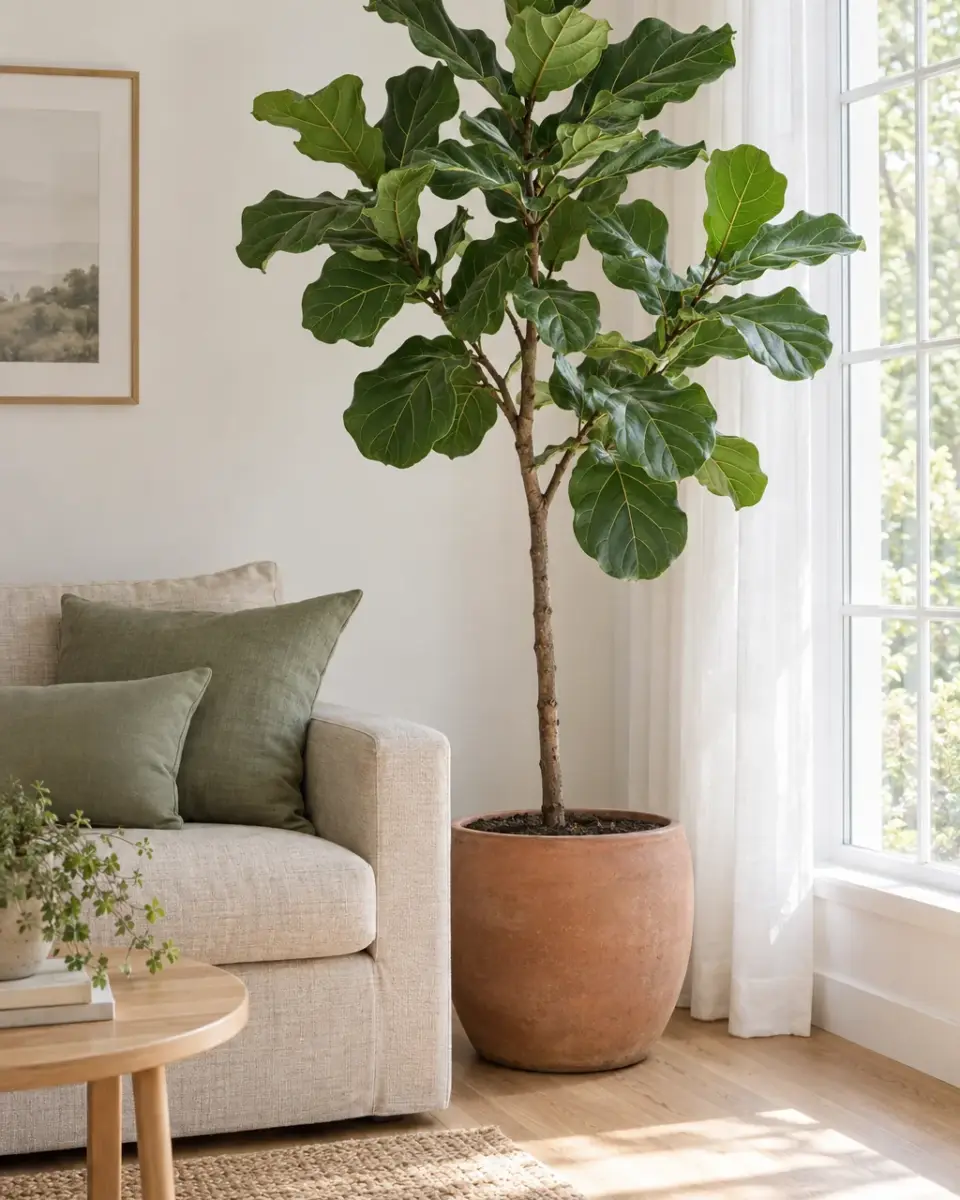
Ficus lyrata grows about 2 to 10 feet tall as a houseplant, with stiff, violin-shaped leaves that can reach 18 inches long, according to NC State Extension’s plant profile. It wants bright indirect light with protection from harsh afternoon sun, so a spot a couple of feet from an east window, or behind a sheer curtain at a south or west window, works well. It also needs temperatures above 55 °F (13 °C) and dislikes heating and cooling vents, which can cause brown spots.
Those big leaves make it look heavy, so give it open floor: at the end of a sofa, where the lowest leaves start above the backrest, or alone beside a tall window. In a small apartment, the ‘Compacta’ cultivar stays under about 5 feet with smaller leaves.
Pick a wide, heavy pot in terracotta or matte ceramic. A tall, top-heavy tree in a light plastic pot tips easily, and a warm terracotta tone keeps all that green from feeling flat against white walls.
Bird of paradise, for the sunniest wall
The white bird of paradise (Strelitzia nicolai) has huge paddle-shaped leaves on long stems. Growers describe it as one of the most light-hungry floor plants: bright light with some direct sun, ideally from a west or south window. It also spreads sideways as much as it climbs, so give it a wide gap rather than a tight corner where leaves rub the wall. Torn, split leaves are normal for this plant and don’t mean it’s failing.
Next to the sofa, a few feet back: rubber plant and dragon tree
The medium zone, 4 to 8 feet from the window, is where most sofas end up. Two plants handle it well.
The rubber plant (Ficus elastica) is usually kept between 2 and 10 feet indoors and grows fast, with glossy oval leaves up to about 17 inches long. Bright indirect light or partial shade suits it, and it prefers to stay in one spot away from cold drafts. Leave it unpruned for a slim, tree-like shape beside a sofa arm, or cut the top to make it branch. Dark-leaved types such as ‘Burgundy’ look striking against a light linen or oatmeal sofa.
The dragon tree (Dracaena marginata, now listed by some botanists as Dracaena reflexa var. angustifolia) reaches about 6 feet as a houseplant. Its leaves are narrow, about half an inch wide, with reddish edges, so the canopy stays airy. That makes it a good choice beside a window or a floor lamp, where a dense plant would block the view. Losing a few lower leaves as it ages is normal. Brown tips often point to fluoride in tap water, so filtered or distilled water helps.
The empty corner far from the window: snake plant, corn plant and kentia palm
A corner 8 feet or more from the glass is low light, and only a few tall plants accept it.
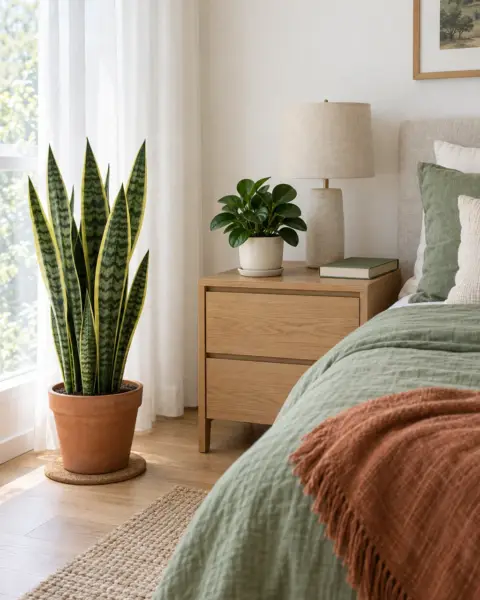
Snake plant (Dracaena trifasciata) sends up stiff, upright leaves that can reach about 4 feet. It tolerates very low light, though it grows slowly there, and its narrow footprint fits corners that can’t spare much floor.
Corn plant (Dracaena fragrans) carries arching, strap-shaped leaves on woody canes and is one of the classic low-light floor plants.
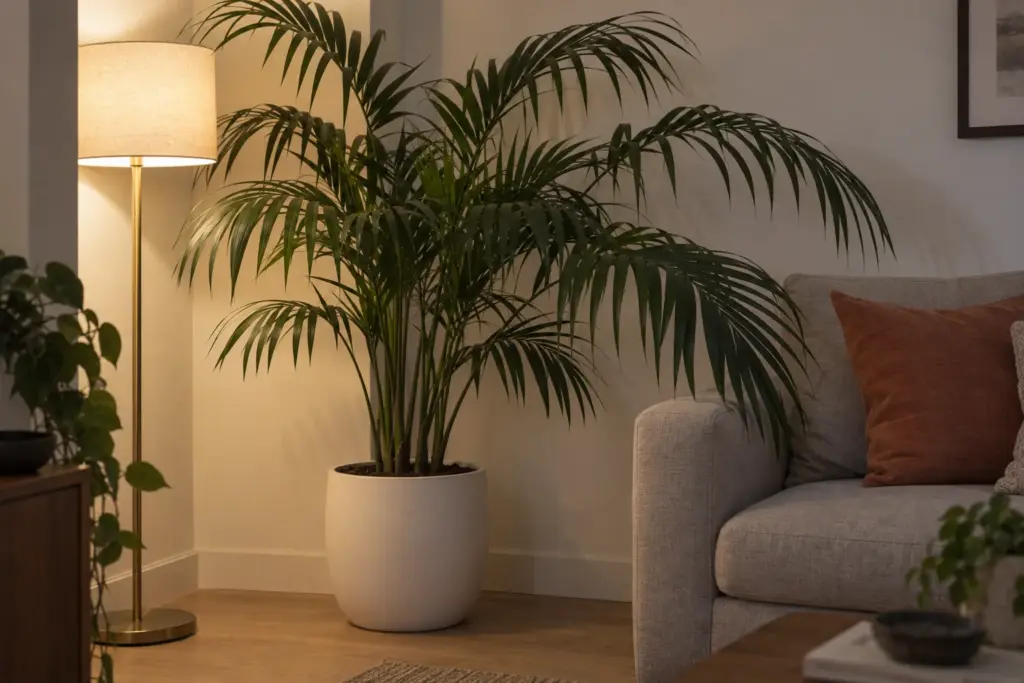
Kentia palm (Howea forsteriana) needs little light, though NC State notes it does best indoors with moderate light and no direct sun. Its feather-shaped fronds arch outward, so it needs more width than the other two. Let the fronds curve over a reading chair or the end of a sofa. It grows slowly, so the size you buy is close to the size you’ll live with for a while.
If the spot is truly dark, consider adding a grow light above the corner or choose the brightest of your dim spots instead.
Between furniture: slim shapes for tight gaps
The gap beside a media console, at the end of a bookshelf or between two windows calls for a narrow plant. Snake plant, dragon tree and a single-stem rubber plant all keep a small footprint while adding height. Leave a few inches between the leaves and the wall so they don’t scrape, and keep walkways clear so nobody brushes past the plant every day.
Check what’s on the floor before you commit: heat registers and air-conditioning vents dry and stress leaves, so never park a plant right over one. If a gap is too short for a floor plant, a mid-size plant raised on a sturdy stand that won’t tip can fake the height.
Pairing one tall plant with smaller ones
One tall plant alone can look lonely, and a crowd of equal pots looks cluttered. Layering heights fixes both:
- The anchor: one tall plant, chosen for the light.
- A middle layer: something 2 to 3 feet tall, such as a parlor palm (Chamaedorea elegans), which tolerates low light and usually stays around 2 to 4 feet indoors.
- A low layer: a small plant on a stool or side table at the anchor’s base, or a trailing plant that softens the edge of the pot.
All three must share the anchor’s light. A low-light corner group of kentia palm and parlor palm works; adding a sun-loving succulent at their feet doesn’t. Tie the group together with the pots: repeat one material, like terracotta or white ceramic, in two or three sizes, and keep the biggest pot under the tallest plant. If you want to go further, the same layering idea scales up to building a full green corner.

Care notes for big plants in a living room
Water by touch, not by calendar. A large pot holds water for a long time, and plants in medium or low light dry out more slowly. Feel the soil a couple of inches down before watering, use pots with drainage holes, and empty the saucer or decorative outer pot afterward.
Turn the pot. Tall plants lean toward the window. A quarter turn every couple of weeks keeps them growing straight.
Dust the leaves. Big, flat leaves collect dust that blocks light. Wipe them regularly with a damp soft cloth.
Pick the spot and leave it there. Fiddle-leaf figs often drop leaves for a few weeks after a move, and rubber plants also prefer to stay put.
Check pet safety. Most popular tall plants, including fiddle-leaf fig, rubber plant, snake plant, corn plant, dragon tree and bird of paradise, appear as toxic to cats and dogs on the ASPCA toxic and non-toxic plant list. Kentia palm and parlor palm are listed as non-toxic.
Tall indoor plant questions about light, size and pets
Which tall indoor plants handle low light best?
Snake plant, corn plant and kentia palm are the most dependable choices for a spot far from the window. They survive low light rather than thrive in it, so expect slow growth and water less often, since the soil stays damp longer.
How fast will a tall floor plant grow?
It depends on the species. NC State rates the rubber plant as a rapid grower, the fiddle-leaf fig as medium, and both the kentia palm and the dragon tree as slow. For slow growers, buy a plant close to the height you want.
Is there a tall plant that’s safe for cats and dogs?
The kentia palm is the easiest large option: the ASPCA lists it as non-toxic to cats and dogs. The parlor palm is also non-toxic but stays smaller, so it works better as a middle layer than as the main statement plant.
Why is a new fiddle-leaf fig dropping leaves?
The usual causes are the move itself, a spot that’s too dark, soil kept too wet, or a nearby vent. Give it bright indirect light, let the top of the soil dry before watering, and avoid moving it again while it settles.
Quick recap: tall indoor plants, spot by spot
- Measure the distance from the window first: under 4 feet is high light, 4 to 8 feet medium, beyond that low.
- Bright window: fiddle-leaf fig or bird of paradise, in a wide, heavy pot.
- Beside the sofa: rubber plant for bold leaves, dragon tree for an airy outline.
- Dim corner: snake plant, corn plant or kentia palm, watered sparingly.
- Narrow gaps: slim shapes, away from vents and walkways.
- Layer one tall plant with a mid-height and a low plant that share its light, and repeat the pot material.
Choose tall indoor plants for the light you have, not the light you wish you had, and the spot will stay green for years. Questions about a tricky corner? Write through the Contact page.