Picture a pothos that came home full and bushy. A few months later, its vines are long and bare between the leaves, and every stem leans toward the window. That stretch means the plant is short on light, and grow lights for indoor plants are the most direct fix when your only window faces north or sits behind a balcony.
This guide explains how a grow light works, why white light suits a living room, which of five designs fits your space, and how to set one up.
Grow lights for indoor plants in plain terms
Plants turn light into the sugars they live on. Without enough of it, they burn through their reserves and growth slows, pales or stalls. Indoors, even the brightest windowsill gets only a fraction of outdoor light, and winter’s short days and low sun make it worse.
A grow light puts out the kinds of light plants use, at a strength that matters when it sits close to the leaves. Across the room, it does very little. And no lamp makes up for a soggy pot, pests, or a plant that needs more sun than an apartment can give.
How a grow light works
Color first. Plants use mostly red and blue light, though they use other colors too. Blue supports chlorophyll production and keeps stems compact. Red drives photosynthesis and flowering, and it also pushes stems to lengthen. A good grow light gives both.
Strength at the leaf comes next. The useful number is PPFD (photosynthetic photon flux density), measured in µmol/m²/s. Lumens describe how bright a lamp looks to people, and watts describe the electricity it uses. Neither tells you what the plant receives. Strength also falls fast with distance: one floor lamp’s published chart shows about 280 µmol/m²/s at 6 inches, 140 at 12 inches and 43 at 24 inches. For scale, the University of Minnesota Extension places low-light plants at roughly 50 to 150, medium-light plants at 150 to 250 and high-light plants at 250 to 450.
Then the hours. What a plant banks is its daily total of light, the daily light integral (DLI). Iowa State University Extension puts low-light foliage plants at 3 to 6 mol/m² per day, medium-light plants at 6 to 10, and succulents and flowering houseplants at 12 to 16. To estimate it, multiply PPFD by hours on, then by 0.0036. A plant getting 140 µmol/m²/s for 12 hours lands near 6: fine for most foliage plants, thin for a cactus.
White light or purple light?
Many grow lights glow pink or purple because they use mostly red and blue LEDs, the colors plants absorb best. They’re efficient, but every leaf under them looks magenta, which makes yellowing, scorch and pests hard to spot.
A white LED is a blue LED coated with phosphors that turn part of the blue into green and red. Michigan State University researchers describe white light as similarly useful to plants as purple light, a little less efficient, and far more pleasant to live with. Adding a few red LEDs keeps the light mostly white.
For a lamp in your living room or bedroom, white is the sensible choice. The University of Maryland Extension suggests a daylight range of roughly 5000 to 6500K for a grow tube and a color rendering index (CRI) of 80 or more, so plants look like themselves. LEDs depend less on the Kelvin number, so a published spectrum graph helps, and some solid white LED grow bulbs sit at a neutral 4000K.
Real benefits of a grow light, and their limits
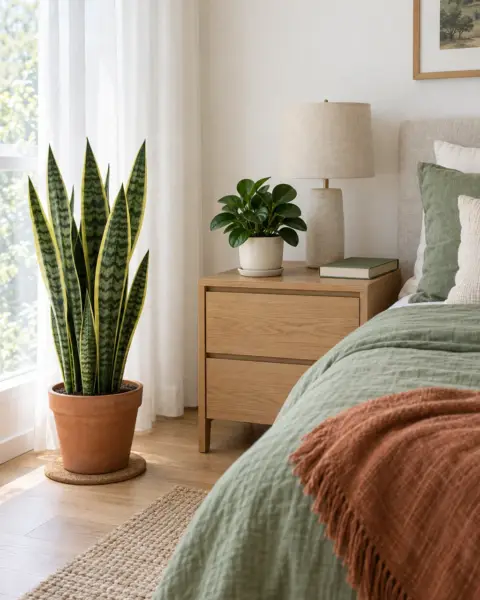
A dark corner becomes usable. You can keep plants where your apartment needs them, not only by the window. The limit is the plant: a pothos, snake plant or ZZ plant can live under a modest lamp, while a cactus, citrus or gardenia needs high light that small lamps rarely deliver. To pick plants for a dim corner before adding a lamp, see these low-light plant corner ideas.
Stretching slows and new leaves return. Owners often describe stalled plants putting out new leaves within a few weeks to a month under a light. That only happens if the lamp sits close enough and runs long enough, and it won’t save a plant with rotting roots.
Winter stops being a slump. A timer gives your plant the same day length in January as in June. The catch: more light means faster drying, so feel the soil before watering instead of following the calendar.
The routine runs itself. A built-in timer that switches the lamp on and off each day is the feature owners praise most. The limit is the presets, often fixed cycles such as 3, 9 or 12 hours, so check that one matches your plant.
It runs cooler than old bulbs. LEDs give off far less heat than incandescent lamps, though bright heads and bulbs still get hot.
Signs you need a grow light (and when you don’t)
The University of Minnesota Extension lists the classic signs of a plant short on light:
- Long, thin stems with wide gaps between leaves, leaning toward the window
- New leaves that come in pale green or yellow
- Older leaves dropping without another obvious cause
- Variegated leaves turning mostly green
- A flowering plant that sets no buds
A north window or a spot far from any window points the same way. You can skip the light if your plant grows compact, even leaves where it is. And if the soil stays wet for days, fix watering first: a lamp won’t rescue a waterlogged pot.
Five types of grow lights for five apartment situations
Each product named below is a current example, described from its manufacturer’s specifications.
A plant on a shelf or side table: a halo light on a stake
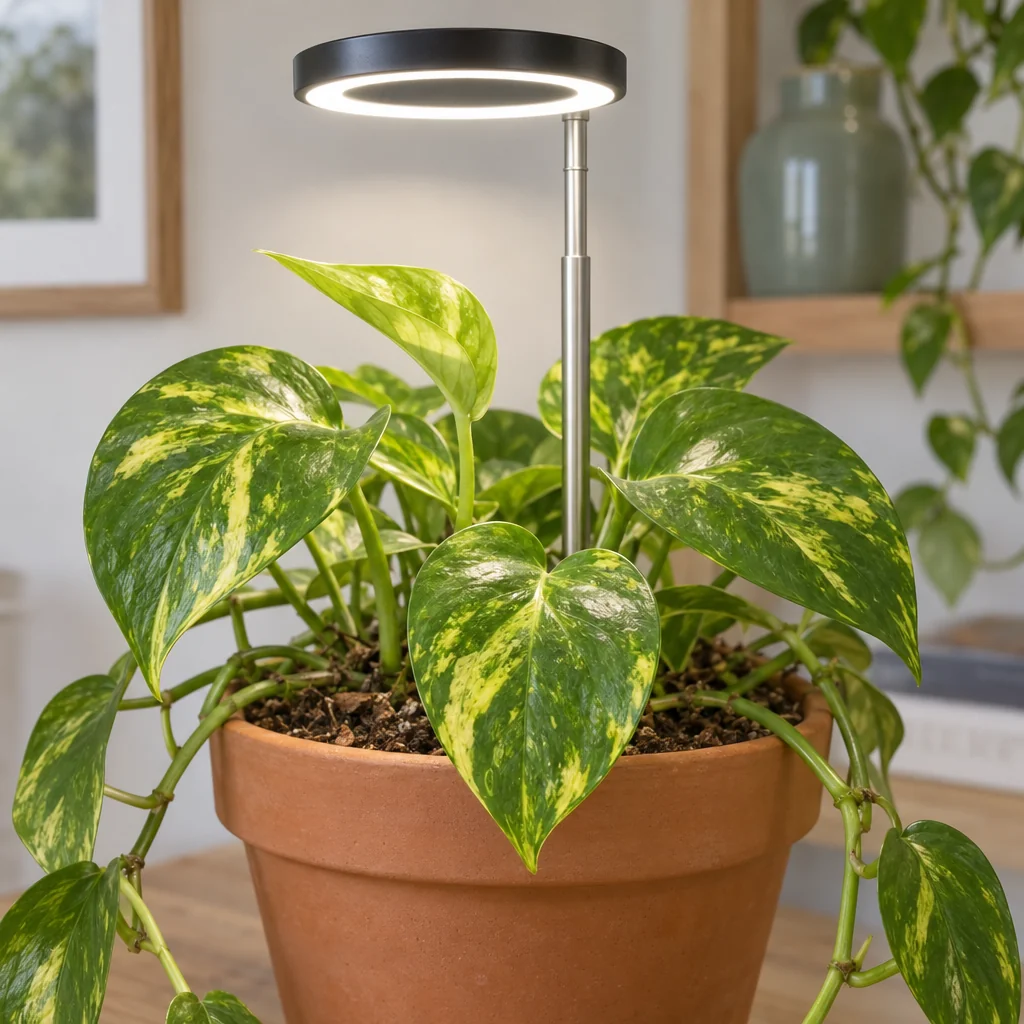
A halo light is a small LED ring on a slim telescoping pole. You push the pole into the soil or stand it in a flat plate that slides under the pot. The LBW halo grow light with base is one example: a ring about 3.5 inches across with 48 LEDs mixing cold white (6000K), warm white (3200K) and a few deep red diodes, a pole adjustable from about 7.8 to 26 inches, three light modes, dimming and a daily timer, powered by USB through a wall adapter. It suits a pothos on a bookshelf or a peperomia on a nightstand. The limit: a small ring lights a small circle. For more ways to arrange a shelf around one, see these houseplant display ideas for shelves and stands.
A desk or kitchen counter: a clip-on gooseneck light
Clip-on lights clamp to the edge of a desk, shelf or counter and bend over your pots on flexible goosenecks. The GooingTop 6000K clip-on grow light (model HY-021) pairs 74 white LEDs with 10 red ones, draws roughly 10 watts according to its manual, and offers five brightness levels and a daily timer of 4, 8 or 12 hours. It suits herbs on a counter or small succulents on a desk. The limit: the clamp needs a sturdy edge, and plants must sit fairly close.
A lamp you already own: a screw-in E26 grow bulb
A grow bulb turns any lamp with a standard E26 socket into a plant light, which makes it the most discreet option. The SANSI 36W BR30 grow bulb gives neutral 4000K white light with high color rendering, and the manufacturer lists about 265 µmol/m²/s at 1 foot. It weighs about a pound, isn’t dimmable, and the brand advises against tightly enclosed fixtures because it needs airflow. The limit: the light goes wherever your lamp points, and the bulb is glaring at eye level.
A big floor plant: a floor lamp with adjustable height
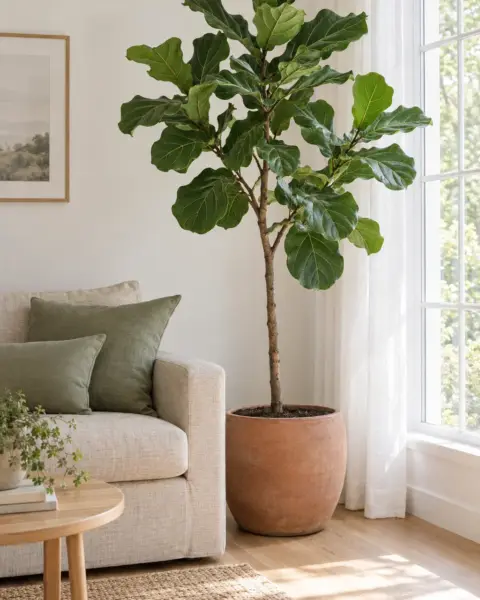
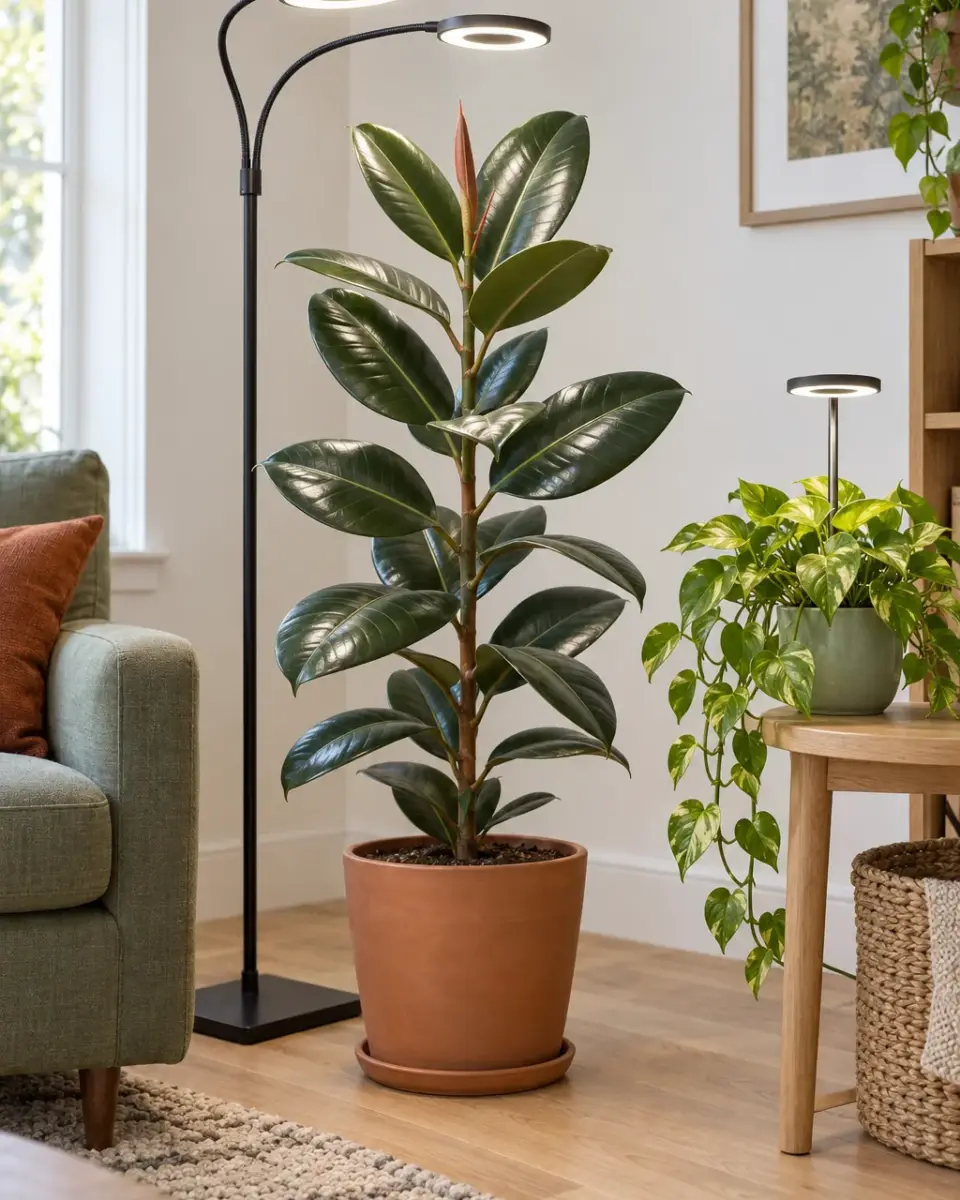
A fiddle-leaf fig, bird of paradise or monstera needs light from above, several feet off the ground. The Glowrium G2 Pro is a 48-watt floor lamp with two 7.87-inch ring heads on goosenecks that extends to about 70.9 inches. Its LEDs are mostly 3000K and 5000K white with some red and blue, three settings shift the balance, and its timer repeats on 3, 9, 12 or 16-hour cycles. The distance chart quoted earlier comes from this lamp. The limit: the flat base plate needs a heavy pot on top or a secure anchor.
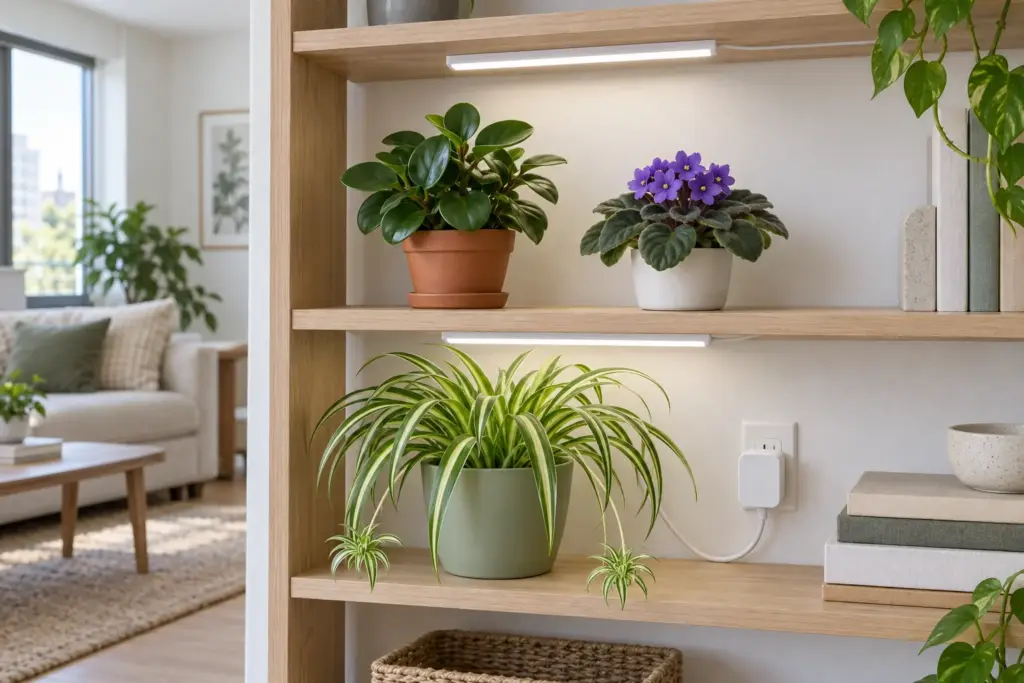
A shelf full of plants: T5 light bars under each shelf
T5 bars are slim strips that mount under a shelf and light the plants below, linked together on one plug. The Barrina T5 1-foot 4-pack uses 5 watts per bar, chains up to 16 bars, gives each bar its own switch, and includes clips, tape and cable ties. It comes in 5000K white, pinkish-white and yellow versions, so choose white for a living space. It suits rows of African violets, peperomias or pothos cuttings. The limit: output is modest, so plants sit close below, and the standard pack has switched cords rather than a timer.
How to choose a grow light: seven checks
- Match the footprint. One small plant needs one ring; several pots need bars or several heads.
- Pick white, full-spectrum light: daylight white around 5000 to 6500K, or a neutral white with a spectrum chart, and a CRI of 80 or more.
- Trust PPFD over watts and lumens. Be wary of “equivalent” wattage, which can be several times what the lamp actually draws.
- Check the adjustments: height, angle and dimming let the light follow the plant.
- Read the timer options. A daily repeat covering 12 to 14 hours suits most foliage plants.
- Judge stability. A wide base, strong clamp or screws beat a narrow plate or tape.
- Look for a safety listing. The University of Maryland Extension advises components certified by a recognized laboratory such as UL, plus outlets, timers and power strips rated for the load.
What owners like and what goes wrong
What owners like:
- The timer, praised more than any other feature.
- Visible change: stalled plants pushing new leaves, stems that stop leaning, citrus and bird of paradise plants putting on new growth.
- Quick setup, especially halo lights whose base plate simply slides under the pot.
- Slim poles and ring heads that fade behind the leaves.
What goes wrong:
- Stability. Owners often add weight or ties: a heavy pot on the plate, a floor lamp pole zip-tied to a plant stand, mounting tape under a halo base for light pots.
- Heat and glare from bright ring heads and bulbs.
- Inline controllers or adapters that fail, sometimes within days, and trouble getting a single replacement part.
- Bar adhesive that loses grip after a few months, and connecting cords that don’t match the shelf.
How to set up a grow light and use it well
- Mount it above the plant, pointing down. Plants lean toward their light, so a side lamp pulls them sideways.
- Set the distance: about 12 to 24 inches above foliage plants and 6 to 12 inches above flowering ones, per the University of Minnesota Extension. A PPFD chart, if your lamp has one, refines this.
- Set the hours: 12 to 14 hours of total light a day for foliage plants, 14 to 16 for flowering ones, and never more than 16. If a window helps, the lamp fills in the rest.
- Watch new growth. Bleached or scorched patches mean too much light; long, pale stems mean too little. Move the lamp a few inches at a time.
- Check the soil more often, since plants under stronger light dry out faster.
- Rotate pots under bars now and then, because the ends are dimmer than the middle.
- Wire it safely: leave a drip loop in the cord below the outlet, don’t chain more fixtures than the manufacturer allows, and keep mist off the lamp.
A smartphone light meter app, held at leaf level, is accurate enough for home use, according to Iowa State University Extension.
Mistakes to avoid with plant lights
- Comparing lamps by watts or lumens.
- Placing the light too far away: on the chart above, going from 12 to 24 inches cuts the light by about two-thirds.
- Running it around the clock.
- Choosing purple light for a room you live in.
- Expecting a small halo to replace a sunny window for a cactus.
- Putting a hot bulb in a closed shade, where trapped heat shortens its life.
FAQ: grow light questions about hours, distance and color
Can grow lights for indoor plants stay on 24 hours a day?
No. Iowa State University Extension recommends 12 to 14 hours a day for most indoor plants, with about 10 as a minimum and 16 as a maximum. Plants respond to the length of the dark period, so a real night is part of the routine.
Will a regular LED bulb work as a grow light?
Partly. A ceiling bulb is usually too far away to matter. Iowa State notes that a bright, full-spectrum LED fixture hung 12 to 24 inches above plants can support medium- to high-light plants, but a grow light gives a better mix of usable light.
How can you tell a grow light is too close?
Bleached, faded or scorched patches on the leaves nearest the lamp are the warning signs. Raise it a few inches, and with bright bulbs, make sure the top leaves don’t feel warm.
Can a grow light stop a Christmas cactus from blooming?
Yes. Christmas cactus (Schlumbergera) and poinsettia need long, uninterrupted nights to set buds, about 10 hours of light or less per day in the blooming season, according to the University of Maryland Extension. In fall, shorten the timer or move the plant to a dark spot at night.
Do grow lights use a lot of electricity?
LED grow lights are among the most efficient plant lights to run. The examples here range from about 5 watts per T5 bar and about 10 watts for a small clip-on to 36 to 48 watts for a strong bulb or a two-head floor lamp.
Quick recap
- Grow lights for indoor plants work only when they sit close and run long enough each day.
- At home, choose white, full-spectrum light around 5000 to 6500K, or a neutral white with a spectrum chart, with a CRI of 80 or more.
- Judge a lamp by PPFD at a distance, not by watts or lumens.
- Match the design to the spot: halo, clip-on, bulb, floor lamp or T5 bars.
- Keep foliage plants 12 to 24 inches below an LED for 12 to 14 hours a day, never past 16.
- Check the soil more often, anchor tall lamps, and use safety-listed gear with a drip loop.
Questions about a tricky corner? Use the Contact page.