A window with nothing in front of it, a kitchen counter already crowded with jars, a bathroom where every shelf is taken. When floor and surface space run out, the ceiling is still free, and that’s where hanging plants indoors earn their place. They pull the eye upward, which makes a small room feel taller.
Up there, though, a plant sits farther from the light, dries out faster and weighs more than you’d guess once watered. This guide pairs each room with plants that suit its real light, plus the hooks, hangers and baskets that keep everything safely overhead.
Where hanging plants indoors get enough light
Indoor light fades much faster than your eyes suggest. Mississippi State University Extension notes that it can drop from about 1,000 to 100 foot-candles within a few feet of a window, and that most plants struggle more than 8 to 10 feet from the glass.
Pick the window before the hook. University of Illinois Extension’s lighting guidelines give a rough map: medium light sits right in front of a north window, a few feet from an east or west window, or 3 to 10 feet back from a south one. Bright light means directly in front of an east or west window, or within about 5 feet of a south-facing one. Then hang the plant beside the window frame, with its leaves roughly level with the glass. A pot hung above the top of the window mostly faces wall and ceiling.
| Plant | Light it needs | How it hangs | Pets (ASPCA) |
|---|---|---|---|
| Heartleaf philodendron (Philodendron hederaceum) | Low to bright indirect | Thin vines, heart-shaped leaves | Toxic |
| Pothos (Epipremnum aureum) | Low to bright indirect, best bright | Long vines, larger leaves | Toxic |
| Spider plant (Chlorophytum comosum) | Medium to bright indirect | Arching grassy leaves with plantlets | Non-toxic |
| Boston fern (Nephrolepis exaltata ‘Bostoniensis’) | Bright indirect | Feathery fronds that arch out | Non-toxic |
| Wax plant (Hoya carnosa) | Bright | Waxy leaves on wiry stems | Non-toxic |
Pothos copes with lower light, but Clemson Extension notes that variegated types lose some color there.
Ceiling hooks, macrame hangers and the weight of wet soil
Screw into a joist whenever you can
Drywall alone can’t carry a hanging pot, and small plastic anchors can pull straight out. The strongest option is a screw hook driven into a wooden ceiling joist (a stud finder locates one). Where there’s no joist, use a swag hook with a toggle bolt, whose spring-loaded wings open behind the drywall, and read the weight rating on the package.
Size that rating to the plant after watering, not the dry pot. Clemson Extension reminds gardeners that containers get much heavier once watered, and Iowa State Extension adds that larger, deeper pots dry more slowly but weigh more. Tug the hook firmly before you let go. Renting, or stuck with old plaster? Ask before drilling, or use a wall bracket screwed into a stud beside the window.
Macrame, chain or bracket
Macrame hangers suit light to medium pots and a relaxed, textured look, especially natural cotton against a white wall. Check that the knotted cradle fits your pot’s diameter. A heavy glazed ceramic pot is safer on a metal chain or a rigid hanger.
Pot material changes your watering rhythm too. Plastic holds moisture longer because it isn’t porous, while terracotta and moss- or coconut-fiber-lined baskets dry quickly, a difference both Iowa State and Illinois Extension point out. Terracotta looks lovely against sage and oak; just water it more often.
Drainage without drips on the floor
Roots need a drainage hole, and your floor needs protection from it. The tidiest setup is a plastic nursery pot with holes slipped inside a decorative hanging basket or planter. Lift out the inner pot, water it at the sink, let it drain, then set it back.

Living room ideas: vines layered by the window
A staggered pair in a bright east or west window
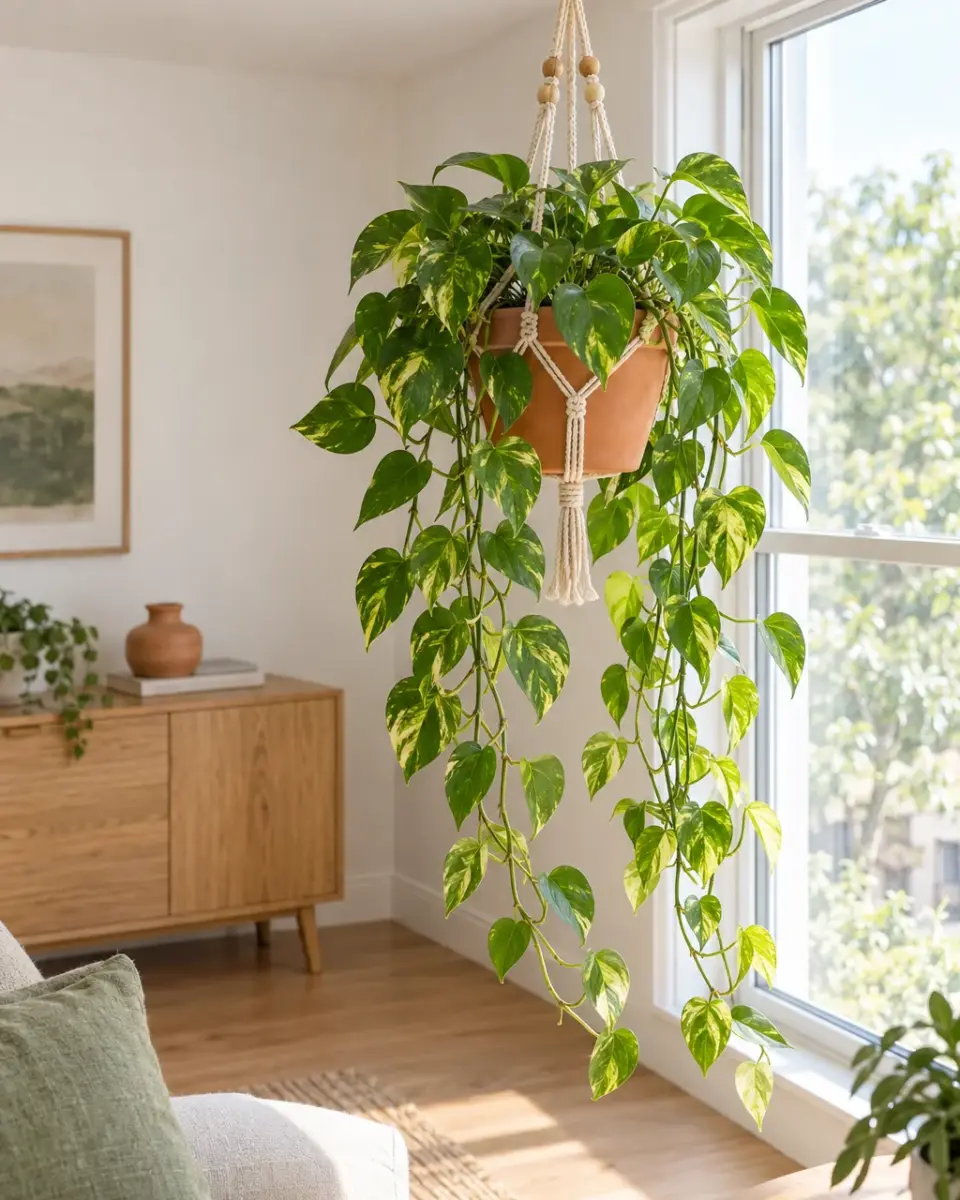
Picture a wax plant hung close to one side of the glass, with a pothos a little lower on the other side. Staggered heights keep the upper plant from shading the lower one and frame the window instead of blocking it. The hoya gets the bright light it needs there (Illinois Extension lists it among high-light houseplants), and Iowa State notes that a hoya in a hanging basket can still flower when the light is strong enough.
For scale, a 6- to 8-inch pot suits an average window; a long sofa wall can carry a 10-inch basket. Wooden beads on a cotton hanger and a terracotta pot suit a sage-and-oak room.
A dim corner that still needs some green
Heartleaf philodendron tolerates very low light better than most houseplants, according to Clemson Extension, and Iowa State describes its 3- to 5-inch heart-shaped leaves trailing from a basket. Hang it within a few feet of a north window. If the corner sits more than 8 to 10 feet from any window, Mississippi State suggests moving plants to better light for 4 to 8 weeks now and then, or see how supplemental plant lighting works.
Kitchen ideas: a spider plant by the sink window
A spider plant is the classic kitchen hanger. Illinois Extension calls it an ideal hanging basket plant, with leaves 1 to 2 feet long, and Clemson Extension says it can spread 2 to 2½ feet wide and trail 2 to 3 feet long in a basket. Its plantlets form after at least three weeks of long, uninterrupted nights, says NC State Extension, so keep it away from late-night overhead lights.
Hang it beside the sink window rather than over the stove, where heat rises, and out of the swing of cabinet doors. Clemson links its common brown leaf tips to excess fertilizer, salty water, low humidity or very dry soil.
Bedroom ideas: soft trailing green that stays out of the way
Bedroom curtains often stay closed part of the day, and nobody wants a pot dangling over the bed. Hang plants in a corner near the window or above a dresser, never over the headboard or a walkway.
In filtered light, pothos or heartleaf philodendron trail softly from a woven seagrass or rattan cachepot. If a cat sleeps in the room, a spider plant or a hoya is the calmer choice, since the ASPCA lists both as non-toxic. Keep the hoya right by the glass, though.
Bathroom ideas: where a Boston fern belongs
A Boston fern earns a bathroom spot only if the room has a real window. The New York Botanical Garden’s Boston fern care notes say it does best in bright, indirect light, sheds leaves continually in low light and bleaches to a yellowish green in hot sun. Dry air yellows its leaves, so NYBG suggests raising humidity once temperatures climb above 70°F (21°C). Keep the root ball moist and the room above its minimum of 50°F (10°C).
NYBG notes the fronds can reach 4 to 6 feet, so hang it in a corner by a frosted window, clear of the shower spray and the door swing.

Watering and care for plants hung up high
Colorado State University Extension explains that hanging baskets dry out faster than any other container, because air reaches them from the sides and the bottom. Check the soil with your finger, not a calendar, and follow each plant’s rule:
- Pothos: let the top of the soil dry between waterings during active growth, and water less in the dim months, per NYBG.
- Hoya: Iowa State says it’s happiest a little on the dry side, with a wet-then-dry cycle.
- Spider plant: moist, well-drained soil in the growing season and less water in winter, per NC State.
- Boston fern: keep the root ball evenly moist.
Water until it runs out of the drainage hole, which Iowa State recommends so the whole root ball gets wet. Do it at the sink or in the shower, and let the pot drip before rehanging it. If the mix ever dries so much that it pulls away from the pot’s sides, it gets hard to rewet, so soak it slowly. For baskets that are hard to reach, WVU Extension suggests a pulley.
Pets and hanging plants: height helps, but it’s not a lock
Pothos and heartleaf philodendron are toxic to cats and dogs. The ASPCA lists insoluble calcium oxalates in pothos, which can cause mouth irritation, drooling, vomiting and trouble swallowing, and University of Florida Extension describes the same crystals in philodendrons. Spider plant, Boston fern and hoya are listed as non-toxic on the ASPCA toxic and non-toxic plant list.
Hanging a toxic plant keeps it from most dogs, but cats climb and long vines trail down. Trim vines well above anything your cat can perch on, and choose a non-toxic plant when in doubt.
Hanging plant questions about hooks, height and watering
What are the easiest hanging plants indoors for a beginner?
Pothos and heartleaf philodendron forgive lower light. A spider plant handles uneven watering well thanks to its thick, fleshy roots, according to University of Wisconsin Extension, and it’s non-toxic to pets. Save hoya for a bright window.
How high should you hang an indoor plant?
Where people walk, keep the bottom of the pot above head height. Elsewhere, aim for leaves roughly level with the window glass and soil you can reach from a small step stool. Hung too high, a plant sits in weaker light and gets watered less.
Do hanging pots need drainage holes?
Yes. Without one, water pools at the bottom and the roots stay soggy. Plant in a pot with holes, set it inside a decorative basket or hanging planter, and water at the sink so nothing drips on the floor.
Quick recap: hanging plants indoors, room by room
- Choose the spot by its light first: within a few feet of the window, leaves level with the glass.
- Match the plant: heartleaf philodendron or pothos for dim spots, spider plant or Boston fern for medium to bright indirect light, hoya for the brightest window.
- Anchor the hook in a joist, or use a toggle bolt rated for the plant’s wet weight.
- Put a pot with drainage inside a decorative hanger and water at the sink.
- Check the soil often, since hanging baskets dry out faster than other containers.
- Keep toxic vines trimmed above pet reach, or choose non-toxic plants.
Start with hanging plants indoors by placing one plant in your brightest window, then add a second at a different height once the first is thriving. Have a tricky spot you’re unsure about? Send it through the Contact page.