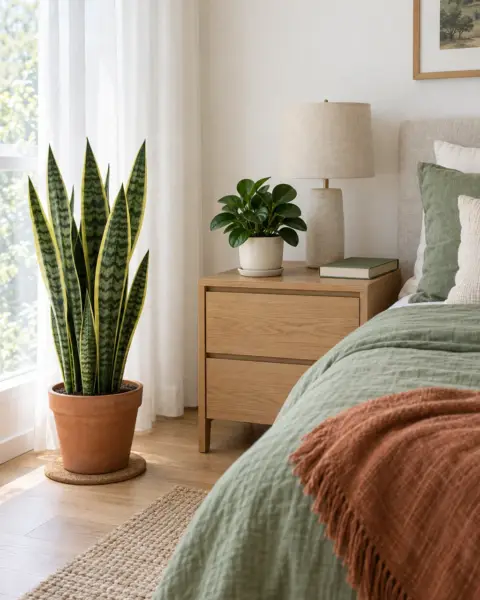
A shelf can hold six or eight plants in the floor space of one, which is why it’s usually the next move once the windowsill fills up. The catch is that a shelf stacks plants vertically, and light doesn’t fall evenly from the top tier to the bottom one, or from the front edge to the back wall. These indoor plant shelf ideas start with that problem, then match each shelf style to the spot and the plants that will actually grow there.
Whether you’re working with one window in a studio or a long living room wall, two questions decide the layout: how much light reaches each shelf, and how big and heavy each plant is.
Indoor plant shelf ideas start with where the light lands
Light fades fast once it comes through the glass. In a University of Kentucky Extension example, a plant one foot from a window gets about four times the light of a plant two feet away, and by three feet the level is too low for most houseplants. A wide shelf unit beside a window can easily put its far end in that dim zone.
Check which way the window faces before you pick a shelf
The window’s direction sets your starting point. According to Colorado State University’s guide to interior plants and light, the area within two feet of an east- or west-facing window gets high light all year, while two to six feet back from that same window drops to medium. A north window gives medium light up close from April through September and only low light from October through March.
So a shelf right next to a south or west window can host sun lovers on its closest tiers. A shelf on the wall across the room is a low-light shelf, whatever it looks like at noon.
Sort plants by light first, then by size
Once you know which tiers get the most light, assign plants in this order:
- Brightest tiers, level with the glass: succulents, cacti and jade. University of Maryland Extension groups cacti and succulents with plants that want four to six hours of direct sun.
- Middle tiers: pothos and heartleaf philodendron, which grow in low to moderate light. Keep variegated types on the brighter end, since University of Minnesota Extension notes that variegated leaves can revert to solid green in too little light.
- Lowest or farthest tiers: ZZ plant and snake plant, both well known for tolerating low light, plus cast-iron plant and peace lily, which Clemson’s Home & Garden Information Center suggests for north exposures or spots several feet from an east window.
Then sort by size. Put the widest, heaviest pots on the bottom, where shelves are usually deepest and the unit is most stable. Save the top for trailing plants whose vines can hang freely, and leave a few inches between the tallest leaves and the shelf above.
Ladder shelves for a bright window or a narrow wall
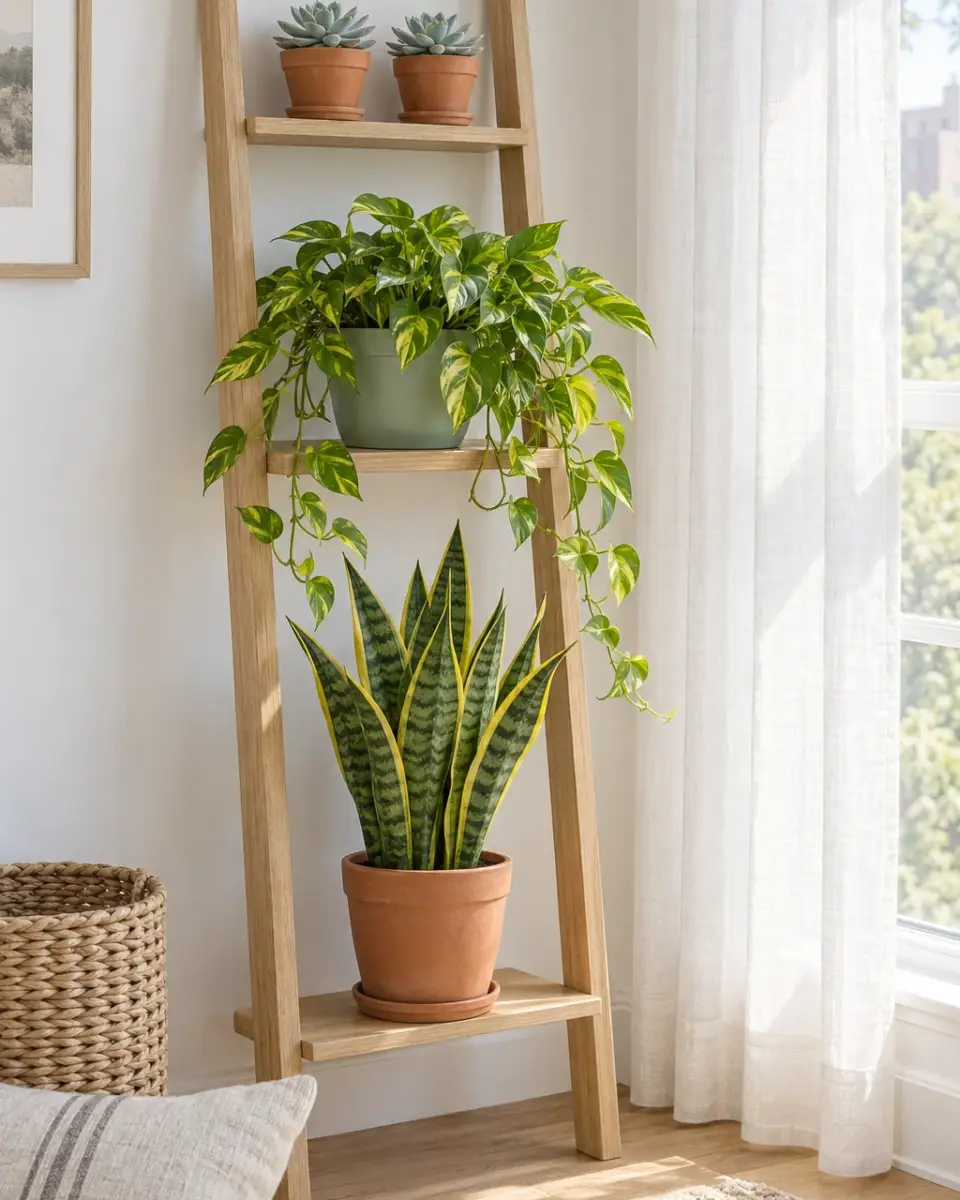
A leaning ladder shelf has deep bottom steps and narrow top ones, and that shape already matches how plants should be placed by size: an 8- or 10-inch pot on the bottom step, small 4-inch pots near the top. It also fits the slim strip of wall beside a window frame, which makes it practical in small apartments.
Watch where the windowsill sits. Any step below the sill line only gets light from above and from what bounces off the walls, so treat those lower steps as your shade shelves even in a sunny room. Put the sun lovers at or above sill height, close to the glass but not touching it.
For a warm, airy look, pair a light oak or whitewashed ladder with terracotta and matte sage ceramic pots. Use the wall bracket that comes with most leaning shelves, and keep the whole unit away from heat registers.
Floating shelves for small spaces and tight kitchens
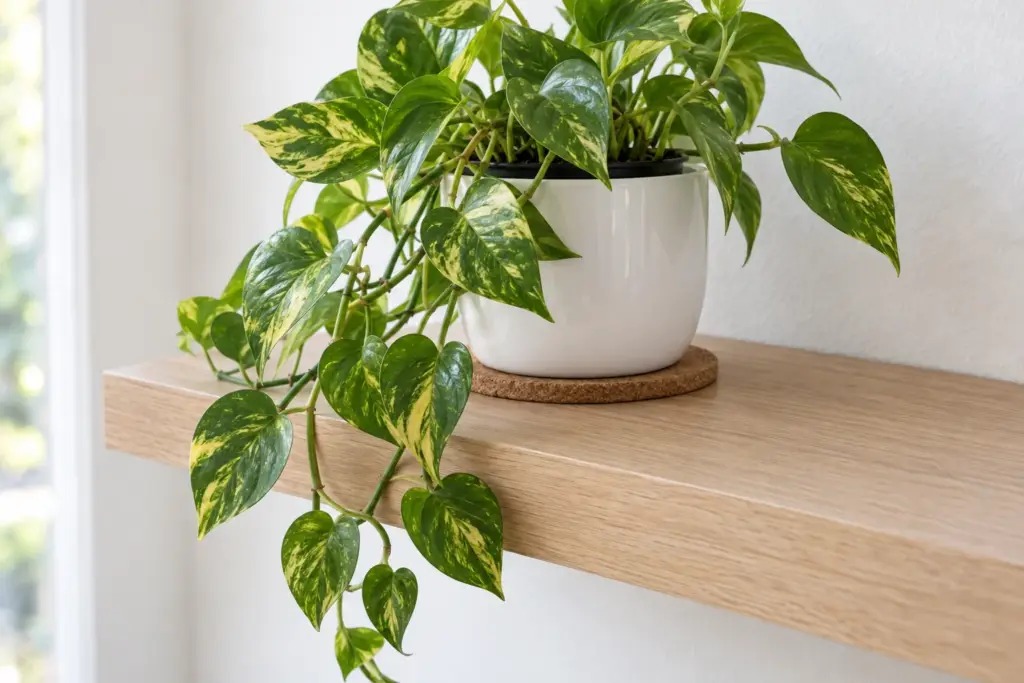
Floating shelves take up no floor space at all, a real advantage in a small kitchen. Their limit is depth. Most are shallow, so they suit 4- to 6-inch pots and compact plants rather than anything bushy.
Wet soil is heavier than it looks, so mount floating shelves into wall studs or with anchors rated for the load, and check the shelf’s weight rating before lining it with ceramic pots. A run of two or three shelves stacked beside a window frame works better than one long shelf across a dim wall, because every pot stays within a few feet of the light.
A trailing pothos on the top shelf softens the hard line of the board, while small upright plants like a compact snake plant hold the lower ones. For more layouts built entirely on the wall, these wall-mounted shelf arrangements go further.
Corner plant shelves for the dim spot nobody uses
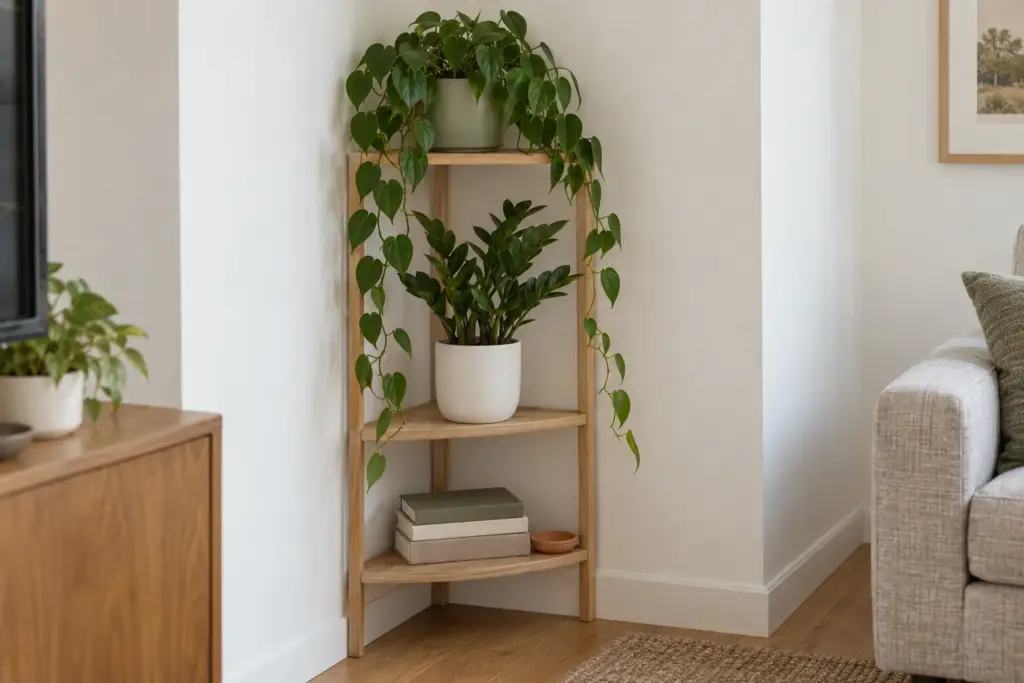
Corners are often the darkest part of a room, and a tiered corner shelf turns that dead angle into display space. Check its light first. A corner several feet from an east window or near a north window suits the low-light group: heartleaf philodendron, ZZ plant, snake plant, cast-iron plant and peace lily.
Plants in a corner get light from one direction, and University of Maryland Extension points out that plants lit from one side tend to lean toward it. Give each pot a quarter turn every week or two so growth stays even. Skip strongly variegated plants here; they’ll do better on a brighter shelf.
A triangular corner unit with four or five tiers works in a small bedroom, while a larger living room can take a wider L-shaped corner shelf. Let a heartleaf philodendron trail from the top tier to tie the levels together. If the corner gets almost no daylight, adding a plant light to a dark spot is the realistic fix.
Bookcases and open shelving for large rooms
A freestanding bookcase or open cube unit holds a real collection, mixed with books. Place it on the wall beside a window rather than across from it, so the cubes nearest the glass can host brighter-light plants and the far side holds the shade-tolerant ones. If the unit works as a room divider, the side facing the window gets the better light.
Tall bookcases need anchoring, especially with heavy pots on the upper shelves. The CPSC’s Anchor It! guidance urges anchoring bookcases securely to the wall, since furniture can tip when a child climbs or pulls on it. Plants up high make a unit more top-heavy, which is another reason to keep large pots low.
Protect books and wood with a saucer or cork pad under every pot, and keep pots off the edges of book stacks. For a bigger statement, pair the bookcase with one tall floor plant beside it to build out a full green corner.
How to arrange plants on a shelf so it looks balanced
Good arrangements mix three plant shapes: upright (snake plant, ZZ), trailing (pothos, heartleaf philodendron) and low or rosette-shaped (succulents). Alternate them across the shelves instead of grouping all the trailers on one level.
Repeat two or three pot materials, such as terracotta, white ceramic and one sage or natural wood accent, so the shelf reads as one display instead of a crowd. Leave some empty space on each shelf, and stagger the plants so they don’t stack in one column.
Scale matters too. In a small room, a few medium plants on a narrow shelf look calmer than a dozen tiny pots. In a large room, repeating the same plant on several shelves creates rhythm that carries across a long wall.
Care notes for plants that live on shelves
Watering is the part shelves make awkward. The simplest method is to carry each pot to the sink, water until it runs out the drainage holes, let it drain and put it back. If you water in place, University of Connecticut Extension advises emptying saucers or cachepots within an hour or so of watering, which also keeps standing water off your shelves.
Keep the plant in a nursery pot with drainage holes and slip it inside a decorative pot, a method extension services call double potting. Keep leaves from touching cold window glass in winter, and wipe dust off leaves now and then so they catch more light.
If you have pets, remember that a high shelf isn’t out of reach for a cat. Pothos, for example, is listed as toxic to cats and dogs on the ASPCA toxic and non-toxic plant list, so check every plant there before it goes on a shelf a pet can reach.
Plant shelf questions about light, weight and watering
What are the best indoor plant shelf ideas for a room without direct sun?
A corner shelf or a bookcase stocked with low-light plants works best: ZZ plant, snake plant, heartleaf philodendron, cast-iron plant and peace lily. If the room is truly dark, add a plant light above the top shelf.
How do you keep water from damaging a wooden shelf?
Use a nursery pot inside a cachepot, or a saucer under every pot, with a cork pad underneath for extra protection. Empty any water that collects within an hour of watering. Watering at the sink avoids the problem entirely.
Which plants look best on the top shelf?
Trailing plants like pothos and heartleaf philodendron, because their vines can hang down over the lower tiers. Pothos tolerates the soil drying moderately between waterings, which helps on a shelf you can’t reach every day.
How much space should you leave between shelves?
Enough that the tallest leaves don’t touch the shelf above, plus a few inches for new growth. If you mount a light under a shelf, follow the fixture’s recommended distance; for a standard fluorescent tube, University of Minnesota Extension suggests about 10 to 12 inches above the plants.
Quick recap of these indoor plant shelf ideas
- Check the window direction and how far each tier sits from the glass.
- Put sun lovers on the tiers closest to and level with the window.
- Place shade-tolerant plants on low, far or corner shelves.
- Keep the biggest, heaviest pots on the bottom and trailing plants on top.
- Anchor tall bookcases and mount floating shelves into studs or rated anchors.
- Use cachepots or saucers, empty extra water, and rotate pots every week or two.
Have a tricky shelf spot you can’t figure out? Send a description through the Contact page.