You have a bare wall, a crowded windowsill, and a picture in your head of green spilling down from tidy shelves. The trouble usually starts after the drill comes out: a pothos stretching toward the glass, a shelf that tilts a little more each month, a dark ring under a pot nobody could reach to empty. The best plant wall shelf ideas settle light, weight and watering access before the styling, because those details decide whether the display still looks good next year.
Below are shelf arrangements that fit real apartment walls, the plants that suit each spot’s actual light, and the practical side inspiration photos skip: what a watered pot weighs, what holds a shelf to drywall, and how to water a top shelf without dripping on the floor.
Plant wall shelf ideas start with how much light your wall gets
Stand at the wall around midday and note where the window is. If a south window gives 100% of the available light, east and west windows give about 60% and a north window about 20%, according to Nebraska Extension’s guide to houseplant light.
Distance matters even more than people expect. Costa Farms describes 0 to 2 feet from a window as bright light, 3 to 6 feet as medium and 6 to 10 feet as low, and notes that a plant right at the window can get 10 to 20 times more light than one across the room. On a shelf wall, the end nearest the frame and the far end are two different growing spots, even if they look equally bright to you. Seasons shift things too: the low winter sun reaches deeper into a room, but days are short and the light still fades fast.
So split the wall into zones. Plants that want bright, indirect light go on the shelves nearest the window; low-light tolerators go farther away. If the whole wall sits more than about 6 feet from the glass, treat it as a low-light wall and choose tough trailing plants, or plan on adding a plug-in light above the shelves. One easy clue that a spot is too dim: a golden pothos loses much of its yellow streaking, since that pattern shows up more strongly in brighter light.
Shelf arrangements that work on real apartment walls
Staggered floating shelves beside a window
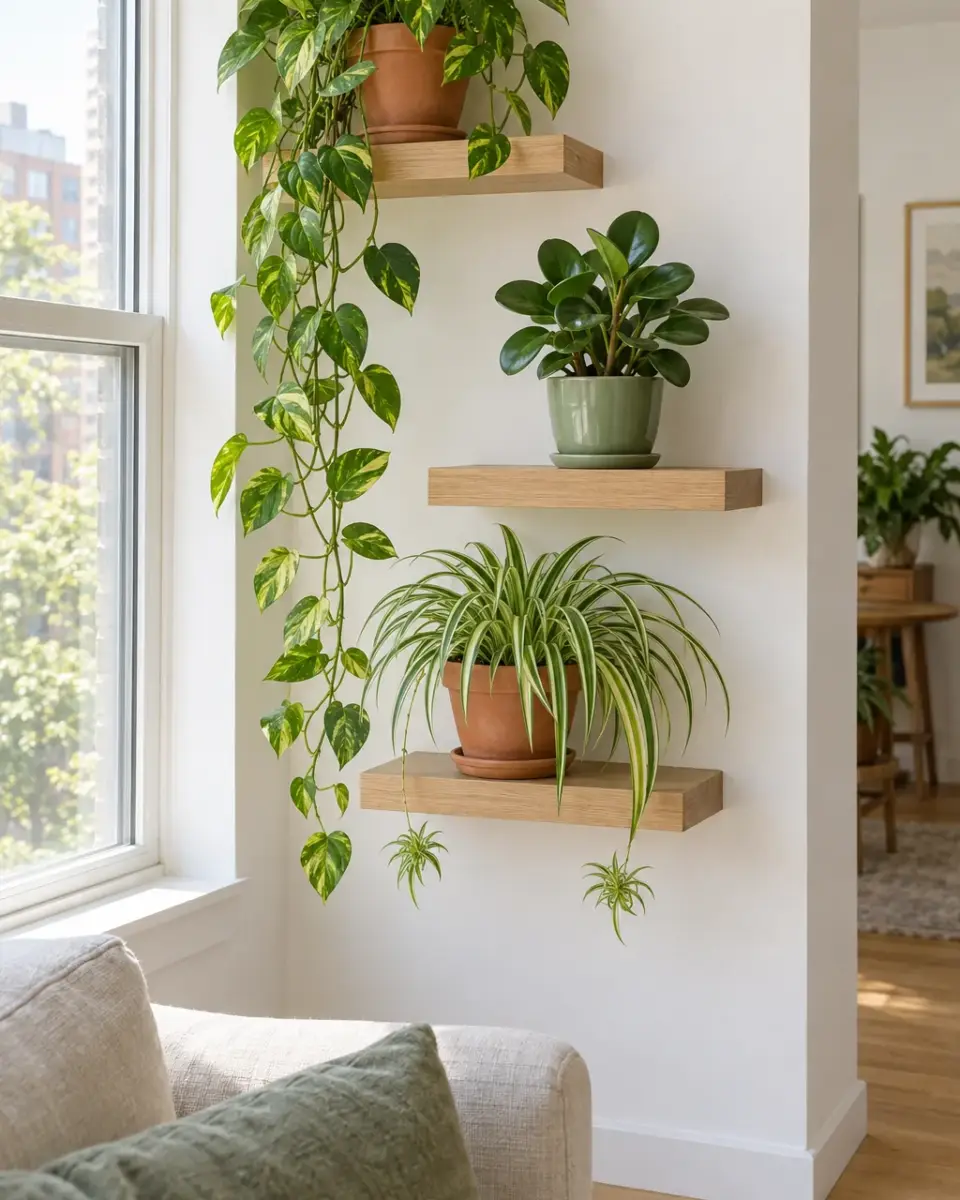
Floating shelves hide their hardware, so the wood and plants do the visual work. Two or three shelves in a loose zigzag along one side of a window look relaxed, and the shelf nearest the frame catches the most light.
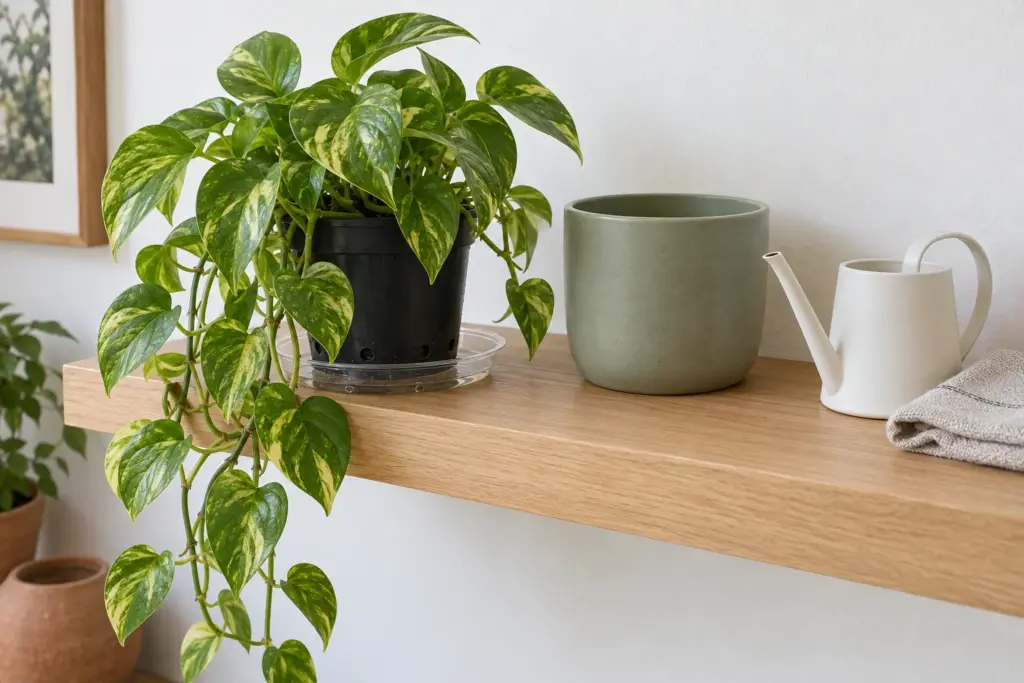
Try a golden pothos (Epipremnum aureum) on top with vines falling past the lower shelves, a compact Peperomia obtusifolia in the middle, and a spider plant (Chlorophytum comosum) at the bottom, where its arching leaves have room. Pothos tolerates very low light but grows best in bright, indirect light. Peperomia prefers medium to bright indirect light. Spider plants handle low to medium light and do best in bright, filtered sun, since strong direct sun can scorch the leaf tips.
White oak or ash shelves pair well with terracotta and sage-glazed pots. Keep pots small on floating shelves, roughly 4 to 6 inches across, and leave enough space between shelves to lift each pot out without tipping it.
Wooden shelves on brackets for heavier pots
Visible brackets carry the load from underneath, so they suit 6- to 8-inch pots or a full row of plants. Black steel brackets with walnut or reclaimed pine feel warm; slim white brackets disappear against a white wall.
Heartleaf philodendron (Philodendron hederaceum) fits here. It tolerates low light and a wide range of indoor temperatures, and its vines stay a little tidier than pothos. The ‘Brasil’ form has lime-green streaks that brighten with more light. Set the heaviest pot directly above a bracket, not mid-span.
A narrow ledge for a bright east or west window
A picture ledge 3 to 4 inches deep, hung right beside a bright east or west window, gives small pots more light than the rest of the room can. A front lip stops them sliding off when you brush past.
A wax plant (Hoya carnosa), with thick, waxy leaves on trailing stems, likes bright, indirect light and needs just the right amount to bloom, so expect to move it around a bit. String of pearls (Senecio rowleyanus) is a true succulent, yet unlike many succulents it can’t tolerate much direct sun.
Corner shelves for a dim spot
Corner shelves fill the angle where two walls meet, often the spot farthest from any window. Pothos and heartleaf philodendron are the reliable picks; pothos can even survive entirely on artificial light, as in a windowless office. Slip plain nursery pots into rattan or seagrass baskets, and expect slower growth and smaller new leaves than near the window.
A leaning ladder shelf when drilling is off the table
If your lease rules out drilling, a leaning ladder shelf or freestanding étagère near the window gives height without holes. Put the heaviest pots on the lowest, widest rungs, and use the wall strap if one comes with it. A spider plant arches nicely from the top rung, with peperomia or hoya in the middle if the ladder stands close to the glass.
How much weight can a floating shelf hold with plants on it?
The plant weighs very little. Wet soil and the pot are what load the shelf. UC Davis measurements of retail potting mixes found wet weights of roughly 51 to 65 pounds per cubic foot, about 7 to 9 pounds for every gallon of mix once watered. Add a glazed ceramic pot and a saucer and a modest plant gets heavier than it looks.
The real limit is the wall. Screws driven into studs hold the most. Plastic expansion anchors in hollow drywall are meant for light loads only, and drywall alone can sag or tear under a heavy shelf over time. Where brackets can’t meet studs, toggle or molly bolts are the usual choice for heavier loads in drywall or plaster.
- Follow the shelf’s own rating. It assumes the installation method in the instructions, so stay well under it.
- Keep heavy pots close to the wall. Weight at the front edge of a floating shelf strains the fasteners most.
- Weigh a watered pot. A bathroom scale right after watering shows what the shelf really carries.
- Check with your landlord. Some leases limit holes, and plaster or concrete walls need their own anchors.

Watering shelf plants without water rings or a step stool
The simplest setup is a plastic nursery pot with drainage holes slipped inside a decorative cachepot. Penn State Extension advises leaving space between the drainage hole and the bottom of the outer container so water drains freely, adding a saucer if needed; see their notes on using a decorative pot as a potholder.
Then watering is easy: lift the nursery pot out, water it at the sink until water runs from the holes, let it drain, and put it back. If you water in place, empty the saucer or cachepot afterward. Roots left sitting in water run short of oxygen and can rot.
Protect the wood too. Unglazed terracotta saucers are porous and can pass moisture to the shelf, and a plain cork pad can hold dampness against the finish. A glazed or plastic saucer, or a cork pad with a plastic backing, is the safer layer.
Height is the other half of watering access. Keep the plants you water most often within reach without a chair, and give the top shelf to plants that like to dry out, such as hoya, which wants its fast-draining mix to dry completely between waterings. Shelves farther from the window also dry more slowly, so they need water less often.
Care notes that keep a shelf display full and safe
Trailing vines and curious pets
Vines hang right into a cat’s reach. Based on the ASPCA plant lists, as summarized in UF/IFAS Extension’s sheet on houseplants and pets, golden pothos is toxic to pets, while peperomia and Hoya carnosa are non-toxic. The ASPCA also lists the spider plant as non-toxic to cats and dogs. Non-toxic doesn’t mean edible, though: a pet that chews a lot of any plant can still get an upset stomach. Keep toxic plants high, trim their vines above jumping height, and check any new plant against the ASPCA list.
Keeping vines full instead of stringy
Pinching out growing tips makes trailing plants branch into a fuller curtain. Cut long vines back in spring just below a healthy leaf, and turn pots now and then so one side doesn’t face the wall for months.
Plant wall shelf questions about depth, renting and dark walls
Which plant wall shelf ideas work for renters who can’t drill?
A leaning ladder shelf or a freestanding étagère beside a window gives vertical space without holes. Keep the heaviest pots low. Adhesive hooks and strips have weight ratings, and a watered pot weighs more than it looks, so read the package before trusting one with a plant.
How deep should a shelf for plants be?
Deep enough for your widest pot plus its saucer, with nothing hanging over the edge. On floating shelves, extra depth adds leverage on the hardware, so deeper shelves need stronger mounting.
Can plants on a wall shelf grow with no window nearby?
A few can. Golden pothos can survive entirely on artificial light, though it grows slowly and loses some of its yellow streaking. Most other plants on a dark wall need a supplemental light.
Do succulents work on wall shelves?
Only right beside a bright south or west window. Desert plants such as cacti need very high light, far more than most shelf walls get. String of pearls is the exception, preferring protection from strong direct sun.
Quick recap: putting these plant wall shelf ideas to work
- Check window direction and distance from the glass before choosing plants for each shelf.
- Put hoya and string of pearls near bright glass, and pothos or heartleaf philodendron in dim corners.
- Use floating shelves for small pots and bracket shelves for heavier ones, mounted into studs whenever possible.
- Plan for wet weight, keep heavy pots near the wall, and stay under the shelf’s rating.
- Use nursery pots with drainage holes inside cachepots, empty saucers, and protect the wood.
- Keep toxic vines out of pets’ reach, and send shelf questions through the Contact page.