You bought a few plants, set each one down wherever there was room, and the living room still looks unfinished. Good indoor plants styling fixes that with a few deliberate choices: which spot gets which plant, how tall each one stands, which leaves sit side by side, and which pots tie it all together. No designer’s eye required, just a plan before you start moving pots around.
The other half of the job is keeping the look alive. A grouping that drops leaves after two weeks isn’t a styling success, so every idea below starts with the light a spot really gets.
Indoor plants styling starts with the light in each spot
Before choosing a plant for that empty corner, find out how much light reaches it. Mississippi State University Extension notes that light can drop from about 1,000 to 100 foot-candles within a few feet of a window, and that spots more than 8 to 10 feet from a window are hard places to grow plants. South windows usually give the most light, east and west windows sit in the middle, and north windows give the least.
University of Illinois Extension offers a quick way to read a room by distance:
- Bright light: directly in front of an east or west window, or up to about 5 feet from a south window.
- Medium light: right in front of a north window, or a few feet from an east or west window.
- Low light: a few feet back from a north window, or 3 to 10 feet from an east or west window.
Match the plant to the spot, not the other way around. Snake plant, ZZ plant and cast iron plant handle low light, while rubber plants and dracaenas want the medium to bright light of an east or west window, according to University of Maryland Extension. If your favorite spot is simply too dim, adding a plant lamp to a dark corner can make it workable.
How to arrange plants by height
Height is what turns a row of pots into an arrangement. Think in layers, from the floor up.
Start with one tall anchor plant
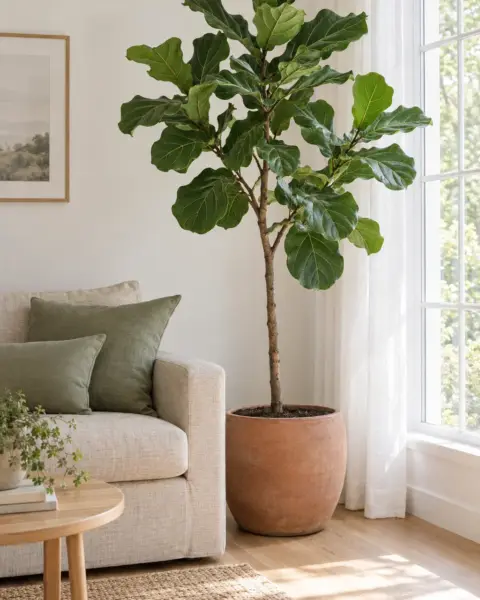
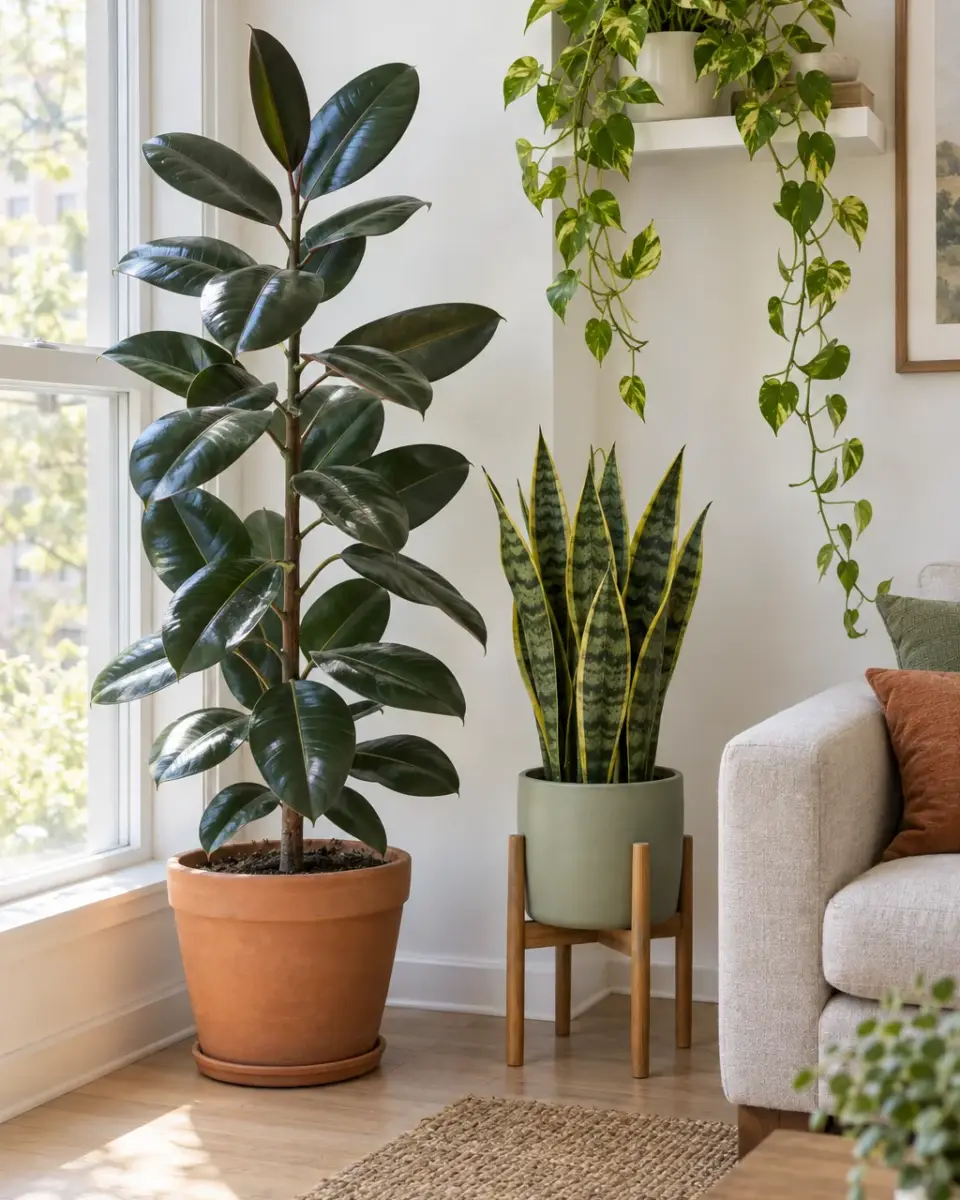
A floor plant that reaches roughly hip height or taller gives the room a vertical line and a focal point. Put it where the light is best, since it’s the hardest plant to move later: beside a window, at the end of a sofa, or in a corner that still gets window light. A rubber plant (Ficus elastica), with its broad, glossy oval leaves, suits a spot near an east or west window. In a dimmer corner, a tall snake plant keeps its upright shape with far less light. For setups matched to each kind of corner, see these plant corner ideas sorted by light.
Raise the middle layer on stands and furniture
Plants in the 1- to 2-foot range look lost on the floor. Lift them onto a plant stand, a stool or a side table so the leaves sit between knee and eye level. Two stands of different heights turn one corner into a stepped group. Natural wood warms up white walls, while slim black metal stands almost disappear and keep the focus on the leaves.
Let trailing plants soften shelves and edges
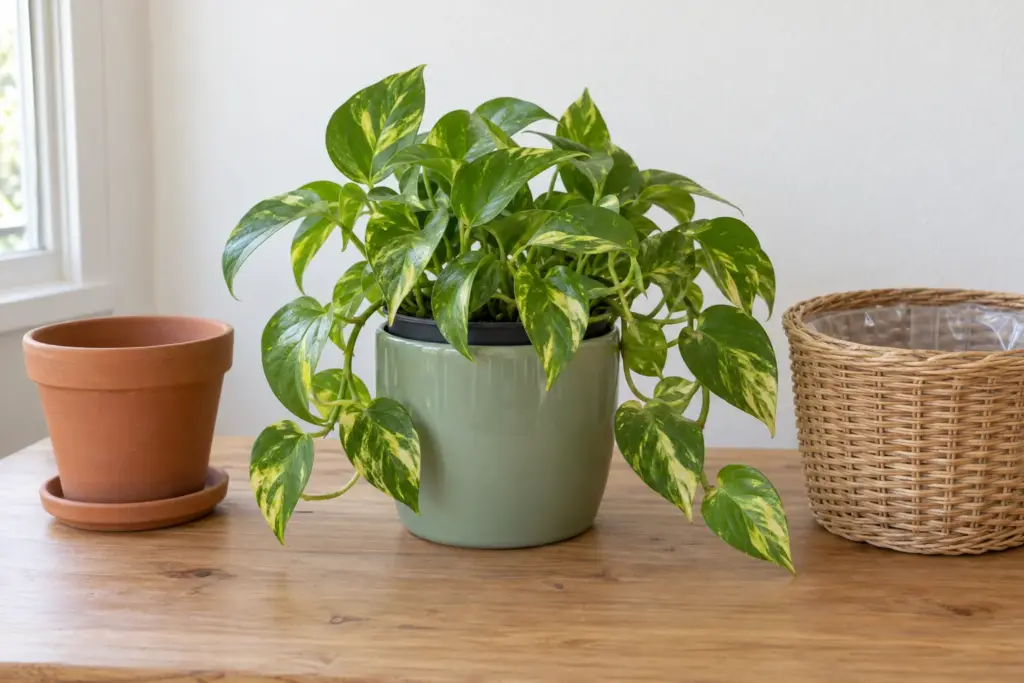
Pothos (Epipremnum aureum) spilling from a bookshelf or the top of a cabinet draws the eye upward. University of Nevada, Reno Extension describes interior plantscaping as using plants to soften hard lines and create focal points, and a trailing vine does exactly that against straight shelf edges. Check the light up there, though: a shelf on the far wall is often dimmer than it looks.
Grouping plants: odd numbers, height steps and breathing room
A single small plant can look like an afterthought, and a perfect pair can feel stiff. Designers often group plants in odd numbers, such as three or five, because the uneven count reads as more natural. Vary the heights so the eye lands on the tallest plant first, then travels down: tallest at the back (or in the center if the group is seen from all sides), shortest in front. From the side, the outline should look roughly like a triangle.
Only group plants that share the same light and watering needs, so one routine works for the whole cluster, and leave a few inches between pots so leaves aren’t crushed and air can move. Iowa State University Extension says grouping raises humidity near the plants, while other horticulture writers describe the effect as minor. Treat it as a small bonus, not a fix for dry winter air.
Mixing leaf shapes and textures without visual clutter
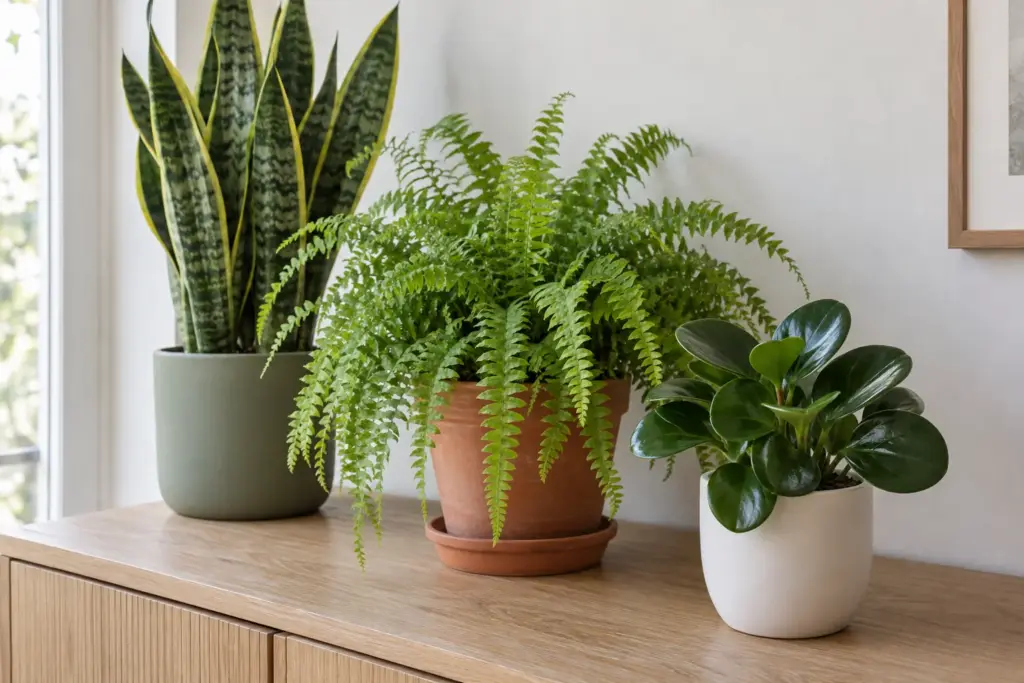
Three plants with the same leaf shape blur into one green mass. The Massachusetts Horticultural Society suggests pairing small, fine leaves with big ones, and soft leaves with hard, waxy foliage. Four leaf types cover most combinations:
- Big, broad leaves, like a rubber plant or a monstera, read bold and pull attention.
- Fine, feathery fronds, like a Boston fern (Nephrolepis exaltata), read soft and make a good backdrop.
- Stiff, upright blades, like a snake plant, add a strong vertical line.
- Small, round, thick leaves, like a baby rubber plant (Peperomia obtusifolia), stay compact on a tabletop.
Combine two or three of these types in a group, with only one bold plant so the large leaves don’t compete. Finish matters too: a glossy leaf next to a matte one adds contrast even when the greens are similar. And one variegated plant in a group stands out more than three.
Choosing pot colors and materials that suit your room
Keep the pot palette to two or three colors
Pots are the easiest place to make a room look intentional. Pick two or three colors and repeat them: terracotta, warm white and sage green suit most bright apartments. If the room already has a strong color, like a rust rug, let one pot pick it up and keep the rest neutral. Matte ceramic suits a minimal room, terracotta and rattan warm up a relaxed one, and black metal fits an industrial look.
Watch the scale. A small pot under a tall plant looks top-heavy and tips more easily, while a wide, heavy base keeps a floor plant steady.
Material and drainage come before looks
Colorado State University Extension’s PlantTalk guide to containers explains that porous clay pots let more air reach the roots but dry the potting mix faster, so plants in terracotta need water more often. Cacti and succulents often do better in unglazed terracotta, while moisture lovers such as Boston fern grow well in plastic or glazed ceramic. Baskets need a plastic liner, and pots with drainage holes need saucers to protect floors.
Many decorative pots have no drainage hole at all. Keep the plant in a plain nursery pot with holes and slip it inside the decorative one, often called a cachepot. Either way, pour off any water that collects in the outer pot so the roots never sit in it.
Styling plants with furniture, room by room
Living room: frame the sofa and fill the bare corner
A reliable setup is a tall plant at one end of the sofa or in the corner nearest the window, a small group on a side table, and one low plant on the coffee table, short enough that you can still see the person across from you. For 25 more setups, from ladder shelves to macramé hangers, browse these indoor plant styling ideas.
Bedroom: fewer plants, calmer shapes
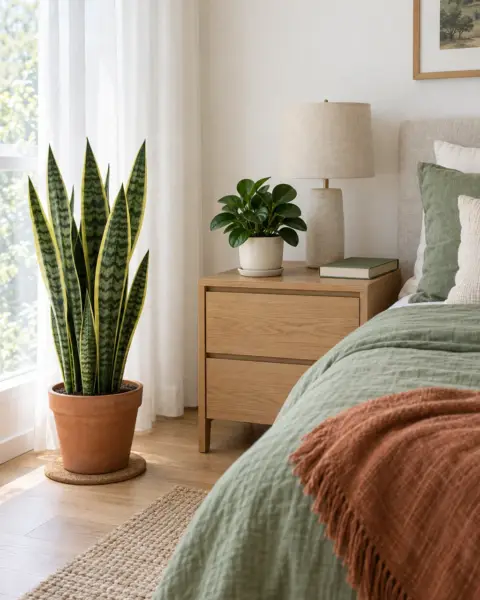
A compact peperomia on a nightstand that gets window light, or a snake plant beside a north window, adds green without visual noise. Light wood, linen and matte ceramic keep the mood soft.
Home office: plants at the edge of your view
A pothos trailing from the top of a bookcase softens a wall of spines, and a small plant on the window side of the desk puts something green in your line of sight.
Care habits that keep a styled arrangement looking good
Plants near a window lean toward the light, so give each pot a quarter turn about once a week, as Utah State University Extension recommends. Keep arrangements away from heat vents, fireplaces, drafty doors and chilly windows, and in winter don’t let leaves touch cold glass. Empty cachepots and saucers a few minutes after watering.
If you share your home with cats or dogs, check every plant before it joins a low group. Pothos and snake plant are listed as toxic to cats and dogs on the ASPCA toxic and non-toxic plant list, while baby rubber plant and Boston fern are listed as non-toxic. Put toxic plants on high shelves, and keep trailing vines short enough that they don’t dangle within reach.
FAQ: plant styling questions about grouping, pots and light
How many plants should you group together?
Three is the easiest starting point, and five works for a larger corner or a long sideboard. Odd numbers tend to look more relaxed than pairs. Mix at least two heights and keep every plant in the group on similar light and watering needs.
What’s the easiest first step in indoor plants styling for beginners?
Start with one spot, not the whole home. Check its light, choose one tall or medium plant that fits it, then add one or two smaller plants with different leaf shapes. Put them in pots from the same two or three colors, and you have a finished corner to build from.
Can you style plants in a room without a bright window?
Yes, but choose the plants first. Snake plant, ZZ plant and cast iron plant handle low light. Spots more than 8 to 10 feet from any window are tough for most plants, so add a plant lamp or keep those corners for decor.
Quick recap: your indoor plants styling plan
- Read the light in each spot before buying or moving a plant.
- Anchor the room with one tall plant where the light is best.
- Lift medium plants onto stands and let trailing plants spill from shelves.
- Group in odd numbers, stepped from tall to short, with plants that share the same needs.
- Pair contrasting leaf shapes, keep pots to two or three colors, and never skip drainage.
- Turn pots weekly, keep plants away from heat and drafts, and place toxic plants out of pets’ reach.
The best indoor plants styling happens one corner at a time: style one spot this week, live with it, then move on to the next. If a tricky spot has you stuck, describe it through the Contact page.