A bare wall above the sofa, a hallway too narrow for a floor plant, a bedroom where every surface is already taken: that’s usually where the idea of a plant wall starts. The best indoor plant wall ideas don’t all need a drill. Some hang from a single screw, some lean against the wall, and one of the easiest is a pothos you teach to climb instead of trail.
What decides whether the wall still looks good in six months is rarely the planter. It’s the match between each plant and the light that wall actually gets, plus a watering routine that keeps drips off the paint.
How to read your wall before trying indoor plant wall ideas
Stand in front of the wall around midday. A wall beside an east- or west-facing window, or a few feet back from a south-facing one, usually gets the bright indirect light most climbing houseplants want. A wall opposite the window or around a corner gets far less than it seems, because the light reaches it at a weak angle.
Pothos (Epipremnum aureum) tolerates lower light, but variegated forms tend to lose some of their color there, according to Clemson Cooperative Extension’s pothos factsheet. Hoya does the opposite: in low light it makes thin, stretched stems and few or no flowers. If the wall you love is simply dim, plan for a plant light mounted above the arrangement rather than hoping the plants adapt.
Note what the wall is made of (drywall, plaster, brick or tile), because that decides the hardware. And avoid a wall above a heating vent or beside a drafty window: hot, dry air and cold drafts both stress leaves.
Wall-mounted planters that turn a wall into a living gallery
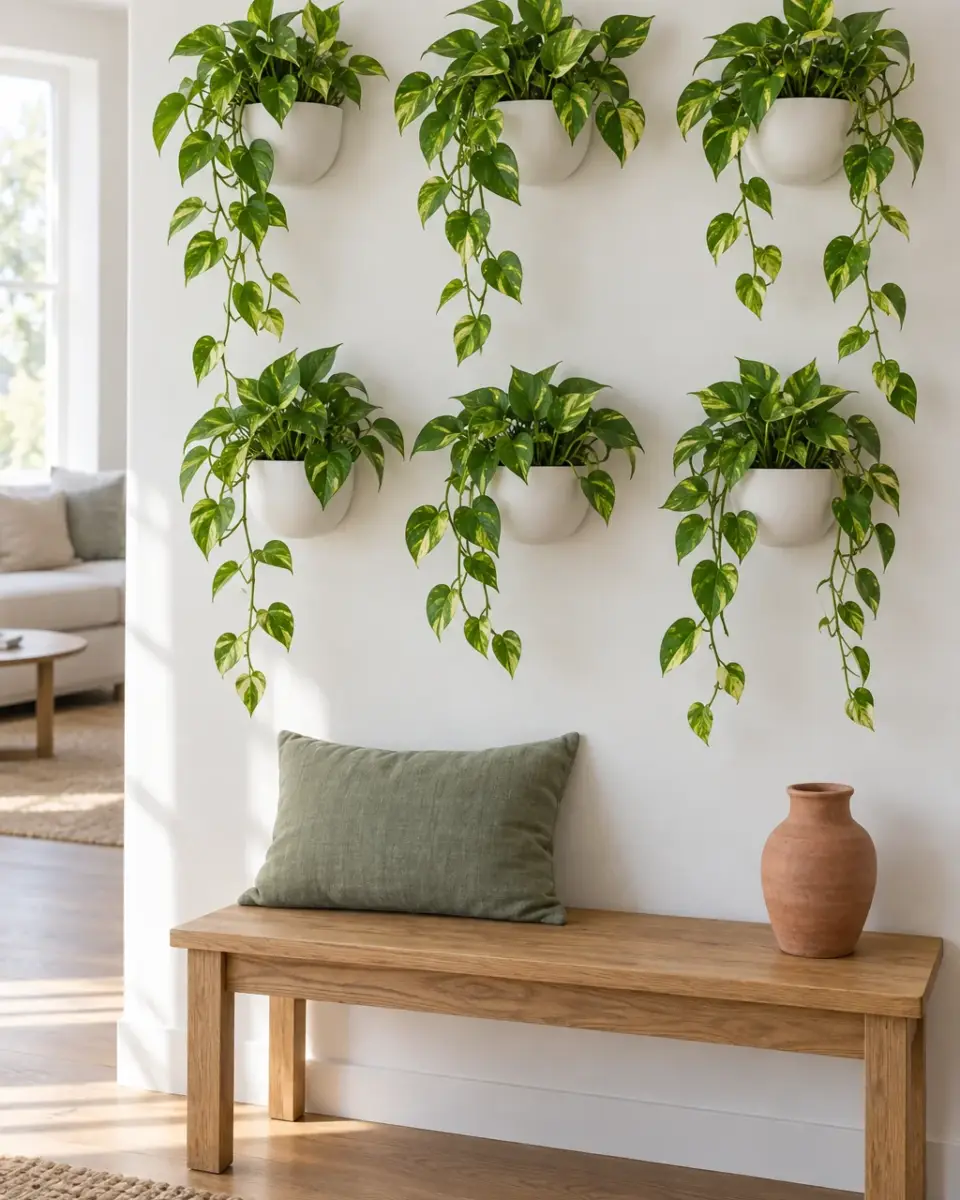
Single wall pots arranged in a loose grid
Three to nine small wall planters in matte ceramic, powder-coated metal or glazed terracotta read as one composition when they share a color and sit in a loose grid. Leave a little more space below each pot than beside it, so trailing stems can fall without tangling into the pot underneath.
Choose planters that hold a plastic nursery pot inside. You lift the plant out, water it at the sink and let it drain before putting it back, so no water reaches the wall. For a medium-light wall, golden pothos and heartleaf philodendron (Philodendron hederaceum) fill out quickly. Hang the top row where you can reach it without a step stool: a plant you have to climb to water is a plant that gets skipped.
For scale, keep the group a little narrower than the sofa, console or bed below it, with at least a forearm’s length between the lowest pot and the furniture top.
Pocket and panel systems for a vertical garden indoors
Felt pocket panels and modular plastic grids hold many plants in one block and come closest to a true living wall indoors. Heavy once watered, they suit owners who can screw into studs.
Put plants with similar light and water needs in the same panel, and set trailing plants along the edges where they can spill over. Choose a system with a waterproof back or a tray at the base, and lay a rubber-backed mat on the floor below.
Climbing plants and indoor trellises that grow up the wall
A freestanding trellis for a no-holes plant wall
If your lease forbids holes, let the pot hold the support. A wooden ladder trellis, a bamboo fan or a black metal grid panel pushed deep into a wide, heavy ceramic or terracotta pot stays upright without touching the wall. The heavier and wider the pot, the taller the trellis it can carry without tipping.
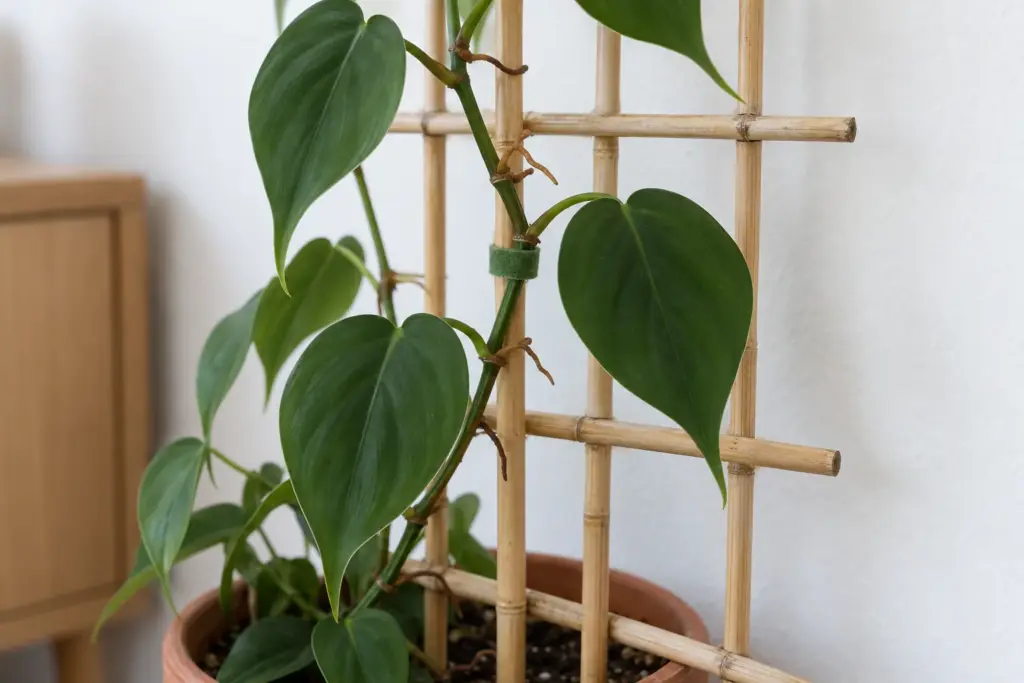
Training pothos and heartleaf philodendron to climb
Both plants grow short aerial roots at the nodes along their stems, and Iowa State University Extension notes that those roots help them climb a trellis or moss pole. Clemson Extension adds that pothos grown upward can produce larger leaves than it does trailing from a basket. Lay the stem against the support with the root side facing it, then hold it with soft plant ties, loosely enough that the stem can thicken.
Heartleaf philodendron is the better choice for the dimmer wall, since it tolerates very low light. The two look alike in the store: pothos leaf stalks are grooved, while heartleaf philodendron stalks are smooth and its leaves feel softer and thinner.
Hoya on a hoop or grid near a bright window
Wax plant (Hoya carnosa) has medium-green, leathery leaves on thin vining stems. It needs high light and a support to wrap around, and it rewards a bright east or west window with clusters of star-shaped flowers. Keep it off cold glass in winter, since it doesn’t tolerate temperatures below 55 °F (13 °C). A metal hoop pushed into the pot, with the stems wound around it, looks tidy on a bright wall.
Why self-clinging vines don’t belong on a rental wall
Creeping fig (Ficus pumila) climbs a surface on its own, which is exactly the problem: University of Florida IFAS Extension notes that its adhesive pads make it hard to remove and that it can damage what it grows on. Keep it in its pot, on a trellis, never on painted drywall.
Mounted staghorn ferns as living wall art
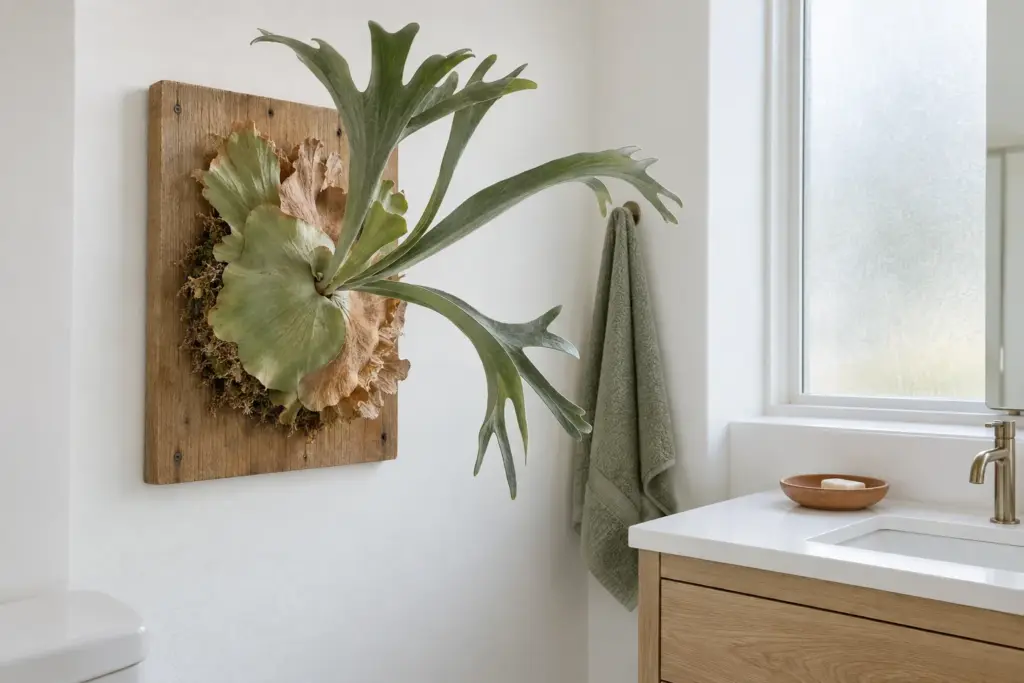
Staghorn fern (Platycerium bifurcatum) grows on trees in the wild, so it doesn’t need a pot. Indoors it’s mounted on a wooden board or bark slab with sphagnum moss behind the roots, held on with fishing line or wire wrapped over the brown, shield-shaped basal fronds, never over the soft green ones. University of Florida IFAS Extension adds one detail: skip copper wire.
It wants bright indirect light, good air circulation, moderate humidity and temperatures above 55 °F (13 °C), as UW–Madison Extension’s staghorn fern guide explains. A bathroom with a real window works well because of the shower humidity. The fern takes up water through its fronds as well as its roots, so the easiest routine is to lift the board down, soak the basal fronds and moss in the sink or tub, let it drip, then rehang it. Let the moss dry a little between soakings, because staghorns rot easily when kept wet.
Leave room around the board: a mature plant can reach 3 feet across. The brown shields that look dead should stay, since they protect the roots.
Plant wall options for renters and homeowners at a glance
| Setup | Holes in the wall | Light it suits | Plants that fit | Watch for |
|---|---|---|---|---|
| Freestanding trellis in a heavy pot | None | Low to bright indirect, by plant | Heartleaf philodendron, pothos | A pot too light for the trellis height |
| Wall pots in a loose grid | One per planter | Medium to bright indirect | Pothos, heartleaf philodendron, hoya | Drips and hard-to-reach top pots |
| Mounted fern board | One or two | Bright indirect | Staghorn fern | Extra weight right after soaking |
| Pocket or panel system | Several, into studs | Bright indirect or a plant light | Tropicals grouped by needs | Weight and water behind the panel |
Prefer something closer to furniture? Floating shelves styled with trailing plants give a similar green wall with less mess, and ceiling hooks and macramé hangers add height without using wall space.
Care notes that keep a plant wall healthy and your paint dry
Check the soil before every watering instead of following a calendar. Pothos likes to dry between waterings, then get a thorough soak. Heartleaf philodendron prefers water once the top of the soil is dry and should never sit in a soggy saucer.
Skip the gravel layer at the bottom of wall pots. University of Missouri Extension explains that it doesn’t improve drainage and pushes the saturated zone of soil higher, closer to the roots. An airy, well-draining potting mix and a drainage hole do the real work.
Weigh one planter right after watering and choose hooks or anchors rated well above that wet weight. Anything heavy belongs in a stud; removable adhesive hooks are only for very light pots. Every few weeks, turn plants that lean toward the window and wipe dust off the leaves.
Pets change the plant list. Pothos and heartleaf philodendron contain insoluble calcium oxalate crystals and are toxic to cats and dogs, so hang them well above jumping height. Wax plant and staghorn fern appear as non-toxic on the ASPCA toxic and non-toxic plant list.
Indoor plant wall questions about light, renting and watering
Which indoor plant wall ideas work on a wall with no direct sun?
Heartleaf philodendron on a trellis or in wall pots is the safest choice, since it tolerates very low light. Solid green pothos also copes, though variegated types may fade. Hoya and staghorn fern need bright indirect light, so save them for a wall near a window or add a plant light.
Can you build a plant wall without drilling?
Yes. A trellis anchored in a heavy pot needs no hardware, and a leaning ladder gives a similar effect. Removable adhesive hooks only suit very light planters, so check the wet weight and your lease first.
Does a living wall clean the air in an apartment?
Not in a way you’d notice. The NASA experiments behind the idea were run in small sealed chambers, and later reviews found that ordinary ventilation replaces indoor air far faster than any realistic number of houseplants can clean it. Grow one for how it looks.
How often should a vertical planter be watered?
There’s no fixed schedule, because each plant dries at its own pace. Check the soil by touch and water plants one at a time. A mounted staghorn needs a soak roughly once a week in warm, dry weather and less often when it’s cool or cloudy.
Quick recap: planning your indoor plant wall
- Check the wall’s light at midday before trying any indoor plant wall ideas, then pick plants that match it.
- Renting? A trellis set in a heavy pot with heartleaf philodendron or pothos needs no holes.
- Have a bright spot? Hoya on a hoop or a staghorn fern on a board makes the most of it.
- Use planters with a lift-out inner pot, water at the sink and skip the gravel layer.
- Match hardware to the wet weight, use studs for anything heavy and hang toxic plants out of pets’ reach.
Stuck on an awkward wall, a dark hallway or a strict lease? Describe it through the Contact page.