A shelf three feet from a window can look bright to you and still leave a plant hungry. That gap explains most shelf disappointments, like the pothos that thins out or the peperomia that leans toward the glass. Choosing plants for shelves works best in this order: the light each level really gets, then the plant, then the pot.
Light changes from the top shelf to the bottom one and from the window end to the wall end, so one bookcase can host very different plants. Here’s what suits each spot, what’s safe within a pet’s reach, and a pot setup that protects the wood.
How to choose plants for shelves by the light each spot gets
Light fades quickly as you move away from the glass. Colorado State University Extension gives practical benchmarks in its guide to interior plants and light: within 2 feet of an east- or west-facing window, plants get high light all year, while 2 to 6 feet back, or a foot to the side, counts as medium light. Within 2 feet of a north window, light is medium from April through September and low from October through March. One tall bookcase beside a window can hold all three levels at once.
Check what blocks the light
Sheer curtains, screens, trees or buildings outside and dirty glass all reduce the light that reaches a plant, according to University of Maryland Extension. Shelves shade each other too, so a low shelf under deep upper boards can sit in shadow most of the day. University of Minnesota Extension describes low light loosely as bright enough to read a newspaper. Anything dimmer at midday is a hard place for any plant: Colorado State notes that few plants tolerate less than 50 foot-candles.
Read what the plant is telling you
A plant short on light grows longer gaps between leaves, turns paler and may drop older leaves, Minnesota Extension explains, and plants lit from one side lean toward the window. Variegated pothos fades toward plain green in dim spots, as the New York Botanical Garden points out. Too much direct sun shows up as pale, browning patches on the leaves facing the glass. Either way, move it one shelf closer or farther and give it a few weeks.
Trailing plants for shelves with room to spill over
Vines suit top shelves and edges because they grow down instead of crowding the shelf above, but only if that shelf gets enough light. A vine near the ceiling on the far side of a room usually ends up thin, with small leaves spaced far apart.
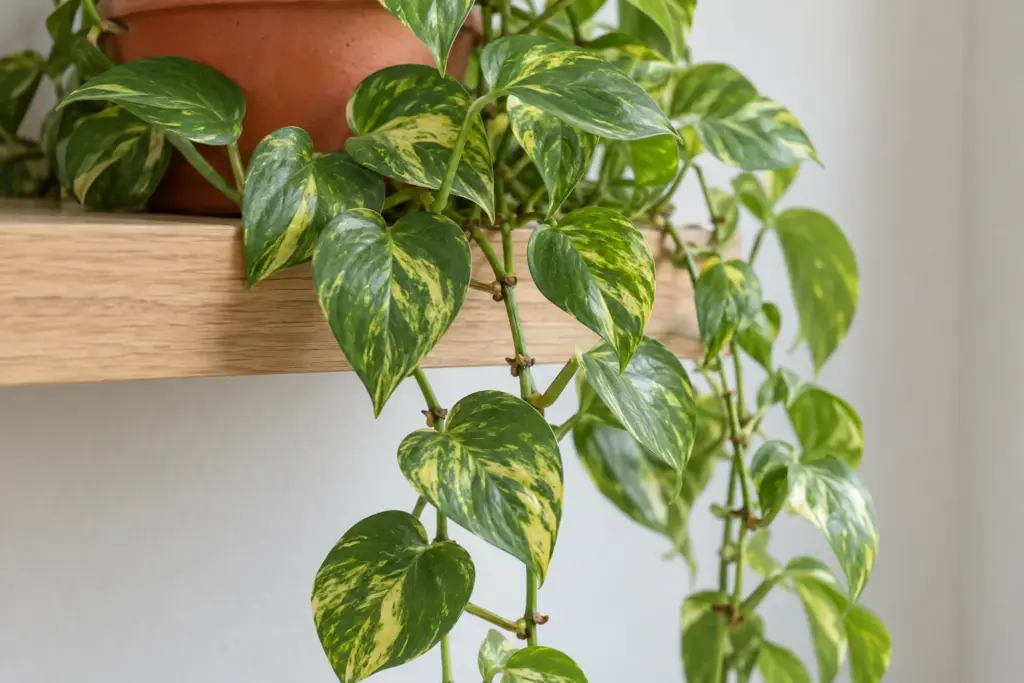
Pothos and heartleaf philodendron for medium or lower light
Golden pothos (Epipremnum aureum) and heartleaf philodendron (Philodendron hederaceum) are the most forgiving trailers for a shelf. University of Florida IFAS describes heartleaf philodendron’s leaves as dark green, heart-shaped and generally 2 to 4 inches long, and Clemson Extension says it tolerates very low light. Pothos copes with imperfect light too, though heavily marbled cultivars lose contrast when it’s dim. Clemson lists lime-green ‘Neon’ among the pothos that handle lower light.
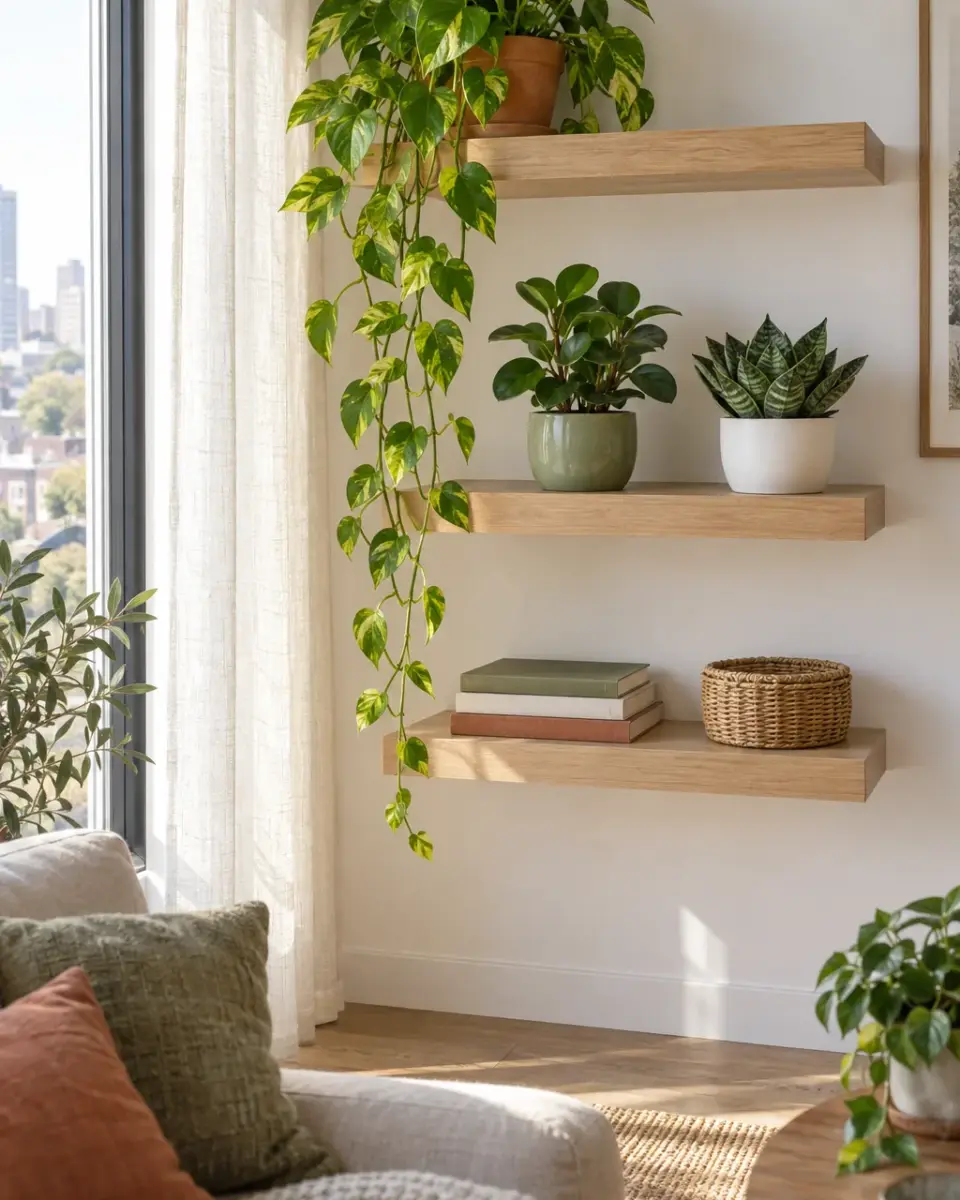
Pothos leaves are thicker and often streaked with yellow or cream; heartleaf philodendron leaves are thinner, with a narrower point. Set either one near the front edge so the vines fall cleanly instead of tangling behind books. A matte white or sage ceramic pot keeps attention on the leaves, and terracotta warms up a dark walnut shelf.
Hoya for a bright shelf near the window
Wax plant (Hoya carnosa) has thick, waxy, oval leaves 3 to 6 inches long on climbing or trailing stems. NC State Extension recommends bright indirect light all year, soil that dries out between waterings, and room-temperature water, since cold water can shock it. It doesn’t mind a snug pot, which suits a shallow shelf; when you repot, go no more than 2 inches wider. Most hoyas don’t bloom until they’re 2 or 3 years old, and the short spurs that flowered will flower again, so leave them on.
Compact plants for eye-level shelves
Peperomia for kitchen and home office shelves
Baby rubber plant (Peperomia obtusifolia) grows thick, glossy, rounded leaves on short upright stems. University of Missouri Extension describes peperomias as forgiving when they dry out and happy in medium to bright light, as long as they stay warmer than 50°F (10°C). That fits a kitchen shelf a few feet from an east window, or a home office shelf beside your desk.
Bird’s nest snake plant for tight vertical space
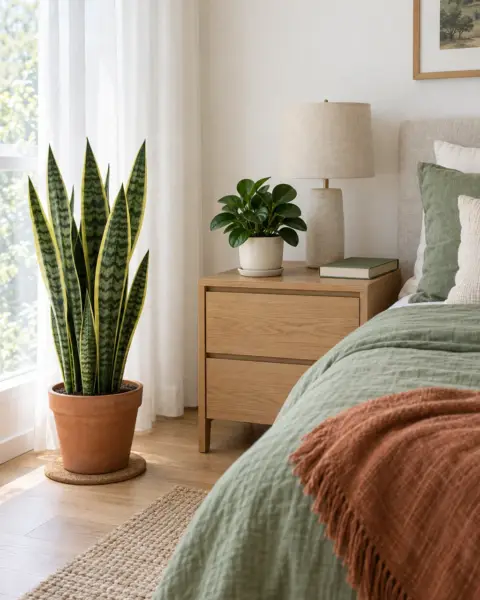
Dracaena trifasciata ‘Hahnii’ is a dwarf snake plant that forms a low rosette of short, broad, stiff leaves banded in dark green and gray-green, usually around 6 to 8 inches tall, while the standard snake plant can reach 2 to 3 feet. Minnesota Extension lists snake plants among low-light houseplants, so ‘Hahnii’ can sit farther from the window than a hoya or a peperomia.
Low light shelf plants for the back of the room
ZZ plant (Zamioculcas zamiifolia) carries glossy, dark green leaflets on upright stems that rise from thick, water-storing rhizomes. UConn Extension says it prefers indirect light but tolerates low natural light, even a windowless office with several hours of fluorescent light a day. Growth slows in dim spots, and overwatering is the usual way to lose one: the leaves yellow and the rhizomes rot. A young plant or the compact ‘Zamicro’, which stays under about 2 feet, fits shelf proportions better than a mature ZZ.
The back of a deep bookcase across the room may still be too dark for any foliage plant. Instead of cycling plants through that spot, consider adding a small grow light or give that shelf to books and objects. If you’re still planning the shelving, the guides to arranging and styling the shelves themselves and to wall-mounted shelving layouts help you place boards where plants will actually grow.
Pet-safe shelf plants for the lower levels
The ASPCA lists these shelf-sized plants as non-toxic to cats and dogs: baby rubber plant, wax plant, parlor palm (Chamaedorea elegans) and spider plant (Chlorophytum comosum). Spider plant’s arching leaves and dangling baby plants look good spilling from a mid-height shelf, but University of Tennessee Extension notes it can be mildly hallucinogenic for some cats, so a dedicated nibbler may still shred it. Parlor palm is often sold small enough for a tabletop, and Clemson Extension says it needs at least 10 hours of bright, indirect light to grow well.
The ASPCA lists snake plant as toxic to cats and dogs, with nausea, vomiting and diarrhea as signs. Pothos, philodendrons and ZZ plant are aroids that contain calcium oxalate crystals, which irritate the mouth. Keep those up high, and remember that a long vine can hang within a pet’s reach. Before buying, check the Latin name on the ASPCA toxic and non-toxic plant list.
Pots, materials and scale that suit a shelf
Colorado State recommends a container 1 to 2 inches wider than the root ball, with drainage holes. Water left in a saucer or decorative cachepot keeps the soil saturated until roots die from lack of oxygen, as UConn Extension explains in its houseplant watering recommendations. The easiest shelf setup: keep each plant in its plastic nursery pot inside a cachepot, lift it out to water at the sink, and put it back once it stops dripping. With saucers, empty them after each watering, as Nebraska Extension advises, and set a cork pad under ceramic so moisture doesn’t mark the wood.
Plastic is nonporous and loses water only through its holes and the soil surface, Virginia Cooperative Extension notes, while unglazed terracotta also dries through its walls. Terracotta suits ZZ plants, snake plants and hoyas; glazed ceramic suits a pothos on a warm, bright shelf.
Leave a few inches of clearance above upright plants, and check the weight rating of floating shelves, since wet soil in ceramic is heavy. Mixed heights look calmer than identical pots: a trailing pothos at one end, a peperomia in the middle, a rattan basket or a few books closing the row. In a living room, give the brightest end to the hoya. In a bedroom facing north, start with a ZZ plant or a ‘Hahnii’.

Care notes for a shelf full of plants
Water each plant on its own schedule. Plants in low light grow more slowly and use less water, Minnesota Extension notes, while those in bright spots dry out faster, so the hoya by the window and the ZZ at the far end won’t need water on the same day. Give each pot a quarter turn when you water so it doesn’t lean toward the glass, wipe dust off broad leaves with a damp cloth, and trim vines before they tangle into the shelf below.
Questions about shelf plants, light and pets
What are the best plants for shelves in a dim room?
ZZ plant, the dwarf snake plant ‘Hahnii’ and heartleaf philodendron handle low light better than most. They grow slowly there and need less water. If the shelf is dimmer than reading light at midday, add a grow light or move the plants closer to a window.
How far from a window can a shelf plant sit?
Colorado State University Extension counts 2 to 6 feet back from an east- or west-facing window as medium light, which suits pothos and peperomia. Farther than that, or beside a north window in winter, stick to low-light plants such as ZZ or ‘Hahnii’.
Which trailing shelf plants are safe for cats?
Wax plant (hoya) and spider plant are both listed as non-toxic to cats and dogs by the ASPCA. Pothos and heartleaf philodendron are not, because they contain calcium oxalate crystals. If your cat climbs the shelves, keep toxic vines in another room.
Quick recap: choosing plants for shelves
- Measure each shelf’s distance from the window and note which way it faces.
- Put pothos or heartleaf philodendron on medium-light edges, and save the brightest shelf for a hoya.
- Use peperomia and the dwarf snake plant ‘Hahnii’ at eye level.
- Give the darkest shelf to a ZZ plant, or add a grow light.
- Within a pet’s reach, choose peperomia, hoya, spider plant or parlor palm.
- Use pots with drainage holes inside cachepots, and water each plant on its own schedule.
The best plants for shelves are the ones matched to the light they’ll actually get, so start with the shelf nearest the window and work outward. Have a tricky shelf in mind? Send your question through the Contact page.