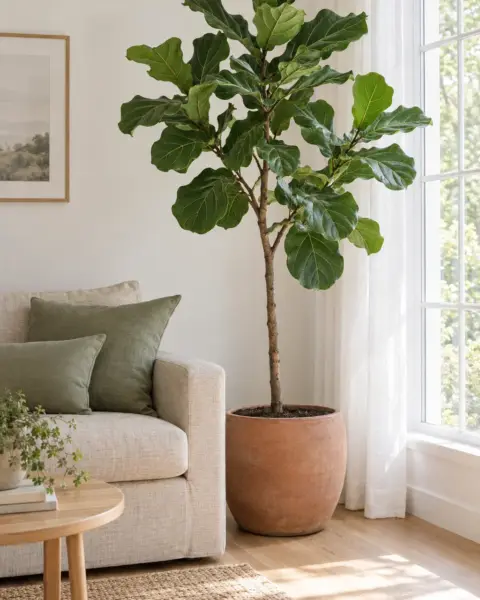
The sofa is where it is, the TV wall isn’t moving, and one window is probably doing most of the work. Good living room plants decor starts from those fixed pieces: you choose each plant for the light its spot really gets, then pick a pot and a shape that fit the style you already have. Do it in the opposite order and the fiddle leaf fig from the inspiration photo ends up dropping leaves behind the armchair.
Living room plants decor starts at the window
The University of Arizona’s guide to indoor plant selection treats spots within about 4 feet of a large south, east or west window as high light, 4 to 8 feet back as medium, and anything farther, like the middle of the room or an inside wall, as low light. North windows often stay in the low range even close to the glass.
In a typical living room, that gives you a quick map:
- The window wall and the floor beside it get the best light.
- A sofa that floats in the middle of the room usually sits in medium light.
- The coffee table and the TV wall opposite the window are often low light.
The University of Minnesota Extension lighting guide puts snake plant, ZZ plant, pothos, philodendron, cast iron plant and parlor palm on its low-light list, and rubber plant, fiddle leaf fig, monstera and ferns with the medium-light plants.
Plant ideas for five living room styles
Modern living room plants with strong outlines
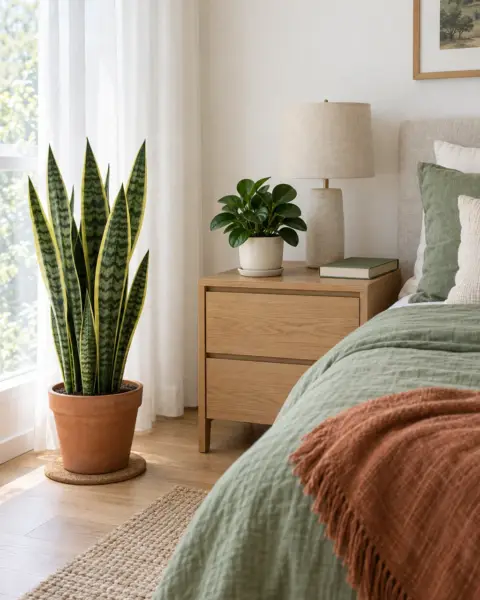
Low sofas, matte black or white finishes, concrete and glass call for plants with a crisp silhouette. Snake plant (Dracaena trifasciata) has stiff, upright, sword-shaped leaves, and ZZ plant (Zamioculcas zamiifolia) carries glossy leaflets on arching stems. Both handle low light, so they can live on the TV wall side of the room.
For height, a rubber plant (Ficus elastica) with dark burgundy leaves looks sculptural next to a gray or leather sofa. It needs medium light, so keep it within about 4 to 8 feet of the window. It copes with less light than a fiddle leaf fig, which makes it the safer tall plant for many apartments.
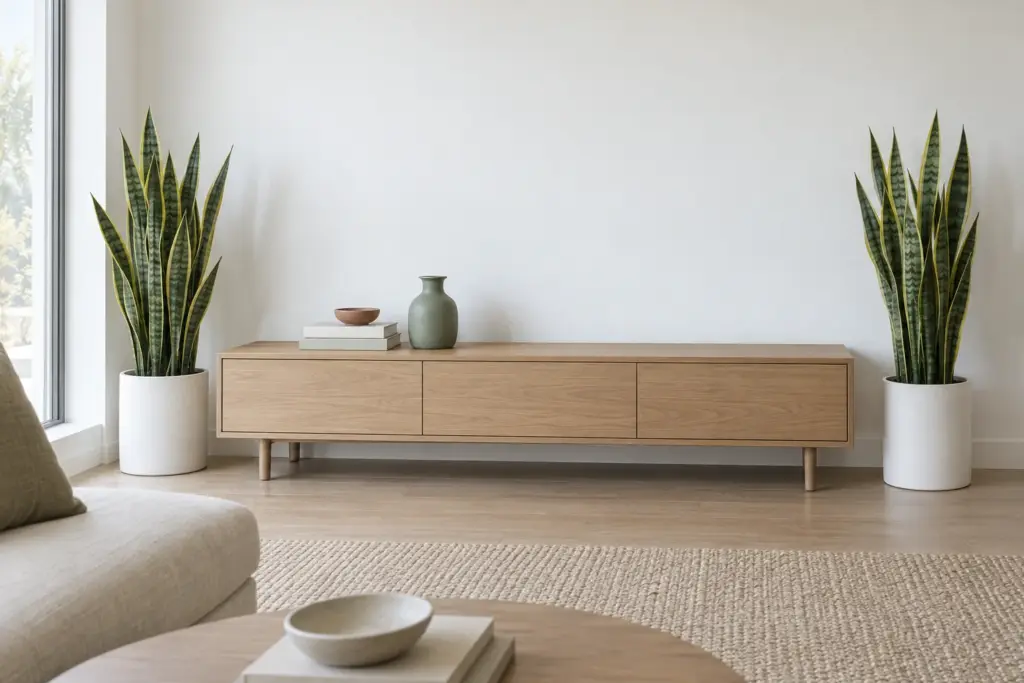
A combination that works: the rubber plant at one end of the sofa, a matched pair of snake plants at each end of the media console, one ZZ plant on a side table. Use smooth cylinder pots in matte white, charcoal or concrete so the leaf shapes stand out.
Farmhouse living room plants with a lived-in feel
Farmhouse rooms mix slipcovered sofas, reclaimed wood, galvanized metal and stoneware. A Boston fern (Nephrolepis exaltata) in a stoneware crock gives the soft, full look this style needs. It wants bright, indirect light, evenly moist soil and a spot well away from heating vents, which dry the fronds into crispy brown tips. For the darker end of the room, cast iron plant (Aspidistra elatior) is the dependable choice: broad, dark green leaves in an upright clump.
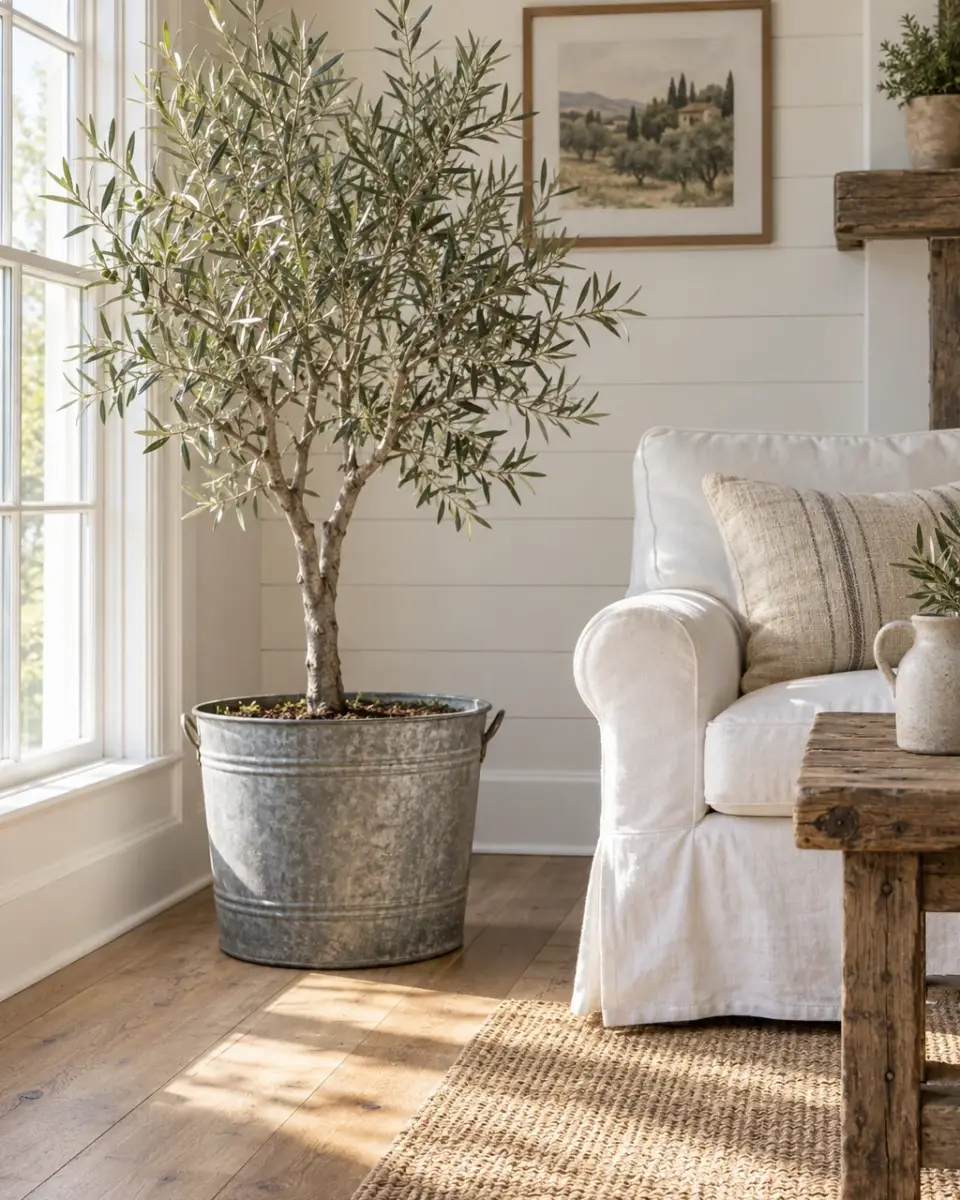
Olive trees (Olea europaea) show up in nearly every farmhouse photo, but they’re the most demanding plant in this guide. Indoors they need as much direct sun as possible, generally at least 6 hours a day from a south-facing window. Without that spot, expect leaf drop.
Galvanized buckets and many crocks have no drainage hole, so keep the plant in its nursery pot inside and pour out any water that collects.
A combination that works: an olive tree in terracotta by a sunny south window if you have one, a Boston fern on a wooden stool beside the armchair, a cast iron plant in a crock at the dim end of the room.
Boho living room plants that trail and spill
Rattan, macramé, jute and pattern mean a boho room can carry more plants than any other style here. Monstera (Monstera deliciosa), with its big split leaves, is the classic floor plant; give it medium light, a few feet back from an east or west window. Pothos (Epipremnum aureum) and heartleaf philodendron (Philodendron hederaceum) trail from shelves and macramé hangers and tolerate lower light, so they work on a high shelf away from the glass. Before hanging one from the ceiling, check the hooks and hangers that can hold a wet pot.
Woven baskets soak up water and can stain floors, so set the nursery pot on a saucer inside.
A combination that works: a monstera in a seagrass basket next to a rattan chair, a pothos trailing from the top of a bookcase, a heartleaf philodendron in a macramé hanger near the window.

Scandinavian living room plants in pale wood and white
White walls, pale oak, linen and wool call for airy greenery. Parlor palm (Chamaedorea elegans) has fine, feathery fronds and tolerates low light, though Clemson Extension notes it grows best in bright, indirect light. Chinese money plant (Pilea peperomioides), with round, coin-shaped leaves on thin stalks, prefers bright, indirect light such as an east or west window, and it leans hard toward the glass, so turn it every week or so.
A combination that works: a parlor palm in a white ceramic pot on a light wood stand beside the sofa, a pilea on the windowsill, one trailing pothos on an open shelf. Stick to white, cream and pale wood; a single terracotta pot adds warmth without breaking the palette.
Minimalist living rooms built around one plant
Minimalism usually means one plant with empty space around it. In a bright room, a fiddle leaf fig (Ficus lyrata) and its large, violin-shaped leaves can carry the whole space. It needs bright, indirect light near your brightest window and a stable spot: moving it, cold drafts and heat vents all trigger leaf drop. In a dimmer room, a tall snake plant in one large pot gives the same clean outline with far less fuss. Choose a plain pot in a single neutral, wide enough to look grounded next to the sofa.
Where to put plants around living room furniture
Beside the sofa
A floor plant at one end of the sofa frames it. Pick one that rises clearly above the sofa back, so it reads as its own piece, and leave enough space that leaves don’t brush your shoulder when you sit down. Near the window, this is a spot for a fiddle leaf fig, rubber plant or monstera. Farther back, a tall snake plant or parlor palm is the realistic choice.
Behind a floating sofa and on the coffee table
A console table behind the sofa puts mid-height plants at eye level as you walk in. Two or three plants in matching pots with different leaf shapes look intentional, like a ZZ plant next to a trailing pothos. Where there’s no console, a sturdy stand that won’t tip does the same job. The coffee table is often the darkest surface in the room, and you look across it, so keep that plant low: a small ZZ plant handles the light, while a pilea only works if the table sits close to the window.
Around the TV and media console
The wall opposite the window is usually low light. A matched pair of snake plants or ZZ plants at each end of the console looks deliberate in modern and minimalist rooms. In boho and Scandinavian rooms, a pothos trailing from a shelf above the TV softens the black screen; just keep the vines from hanging over it.
In an empty corner
A corner next to the window is the best spot in the room for a big floor plant. A dark corner far from the glass needs cast iron plant or ZZ, or extra light. Adding a white grow light lets that corner hold a monstera or rubber plant; University of Minnesota Extension suggests keeping the light 12 to 24 inches above foliage plants for 12 to 14 hours a day.
Care notes for a styled living room
- Heat sources. Keep plants out of the path of heating vents, radiators and the fireplace. Dry, warm air and sudden temperature swings bring brown edges and dropped leaves.
- Drainage. Every decorative pot without a hole needs an inner pot that drains. Empty standing water after watering, and use a saucer on rugs and wood floors.
- Rotation and dust. A quarter turn every week or two keeps a floor plant even, and a damp cloth keeps big leaves clean enough to use all the light they get.
- Pets. Snake plant, pothos, philodendron and monstera are toxic to cats and dogs, and ZZ plant and fiddle leaf fig are also reported as toxic. Check any new plant against the ASPCA toxic and non-toxic plant list.
Living room plant questions about light, pets and mixing styles
Is living room plants decor safe with cats and dogs?
It can be, if you build it around non-toxic plants. Parlor palm, Boston fern and cast iron plant are listed by the ASPCA as non-toxic to cats and dogs, and together they cover low to medium light. If you keep pothos or snake plant, put them where pets can’t reach or chew them.
Can you mix boho plants into a Scandinavian or modern room?
Yes. The pot and the number of plants matter more than the species. A monstera in a white ceramic pot looks Scandinavian; the same plant in a seagrass basket surrounded by trailing vines looks boho. Pick one family of pot materials and repeat it across the room.
How many plants does a living room need?
Fewer than most inspiration photos suggest. Start with one anchor plant beside the sofa or in an empty corner, then add two or three smaller plants at different heights: one on the console, one trailing from a shelf, one on a side table. Add more only when every plant you already own sits in light it can use. A few healthy plants make a stronger room than a crowd of struggling ones.
Quick recap: planning your living room plants decor
- Map the light: within about 4 feet of a bright window is high, 4 to 8 feet is medium, farther back is low.
- Choose each plant for its spot’s light, then choose the pot for your style.
- Modern: snake plant, ZZ, rubber plant. Farmhouse: Boston fern, cast iron plant, olive tree only by a sunny south window.
- Boho: monstera, pothos, philodendron in baskets and hangers. Scandinavian: parlor palm and pilea. Minimalist: one statement plant.
- Frame the sofa with a tall plant, keep the coffee table plant low, and keep every plant away from vents and the fireplace.
Unsure about your own layout? Describe it through the Contact page.