You buy one plant, then another, and somewhere around the sixth pot the room starts to feel busy instead of fresh. Usually the plants aren’t the problem. A pot on every windowsill, a vine on every shelf and a floor plant squeezed into whatever gap was left give the eye nowhere to settle.
Learning how to display plants indoors comes down to two decisions made in the right order: where the usable light really is, and which level of the room each plant belongs to. Floor, table, shelf and ceiling each do a different job. Once every plant has a level and a spot that suits its light, floor plants, shelves, tables and hanging planters read as one arrangement instead of a crowd.
How to display plants indoors: start with the light, not the empty surfaces
Most plant clutter begins when a pot goes wherever there’s a free surface. A plant parked in too little light grows long, thin stems that reach toward the window, with leaves spaced far apart, dropped older leaves and variegated foliage that turns plain green, as the University of Minnesota Extension guide to indoor light explains. A stretched, half-bare plant looks messy even when it’s alone on the table.
Find the bright, medium and dim zones in each room
Light fades fast as you step back from the glass. Oklahoma State University Extension puts it simply: most houseplants need the kind of light found within four to eight feet of a bright south window. Window direction matters just as much. Nebraska Extension estimates that a north window gives roughly a fifth of the light of an unobstructed south window, with east and west windows somewhere in between.
Walk the room around midday. The few feet nearest a south or west window are your bright zone. An east window, or a spot a few steps back from a bright one, is medium. North windows, hallways and far corners are low light. White walls and pale floors bounce a little extra light around.
Then cast plants by zone, following the UMN light lists:
- Low light: ZZ plant, snake plant, pothos, cast iron plant, Chinese evergreen, parlor palm.
- Medium light: rubber plant, spider plant, peperomia, hoya, monstera.
- Bright, sunny windows: succulents and cacti.
Give each wall one anchor plant
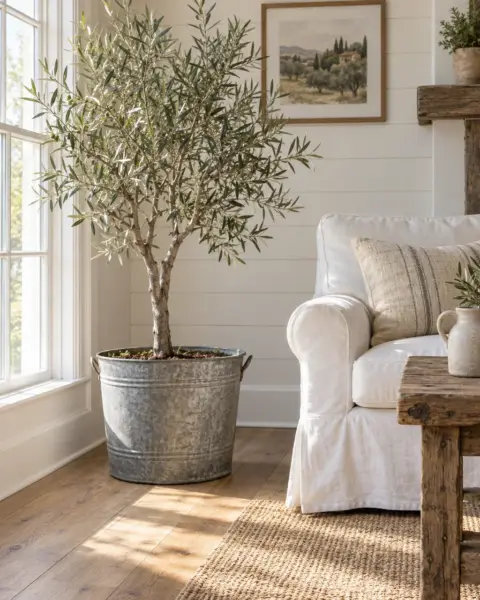
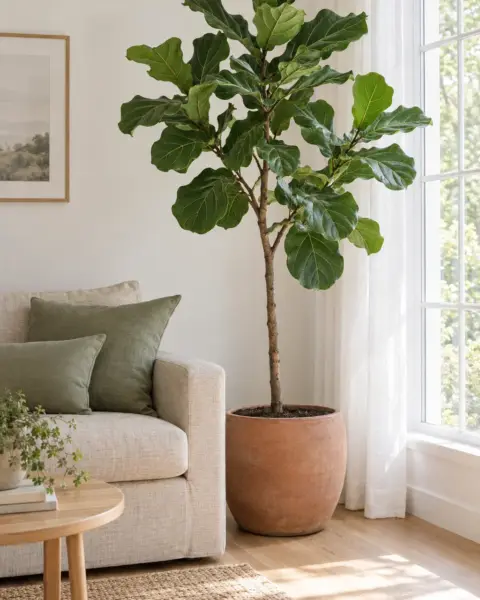
Pick the single largest plant for each wall or corner and let it lead. Everything around it stays smaller and lower, so the eye reads one clear shape plus supporting details. If the biggest plant you own is only 2 feet tall, raise it on a stool or stand so it can do the anchor’s job without disappearing next to the sofa.
Combining floor plants, shelves, tables and hanging planters
Think of the room in layers, each with its own job.
Floor plants: structure and height
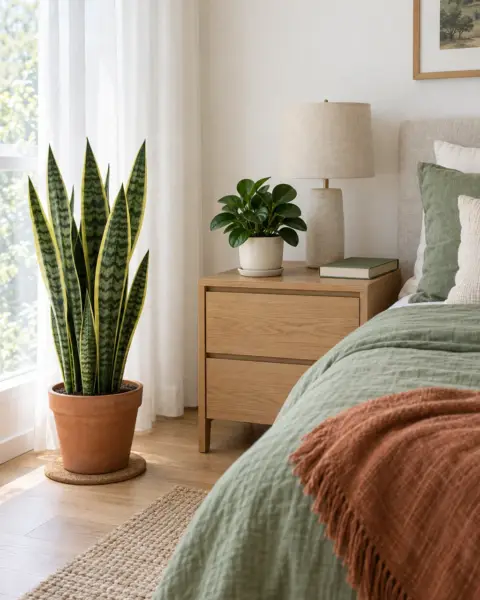
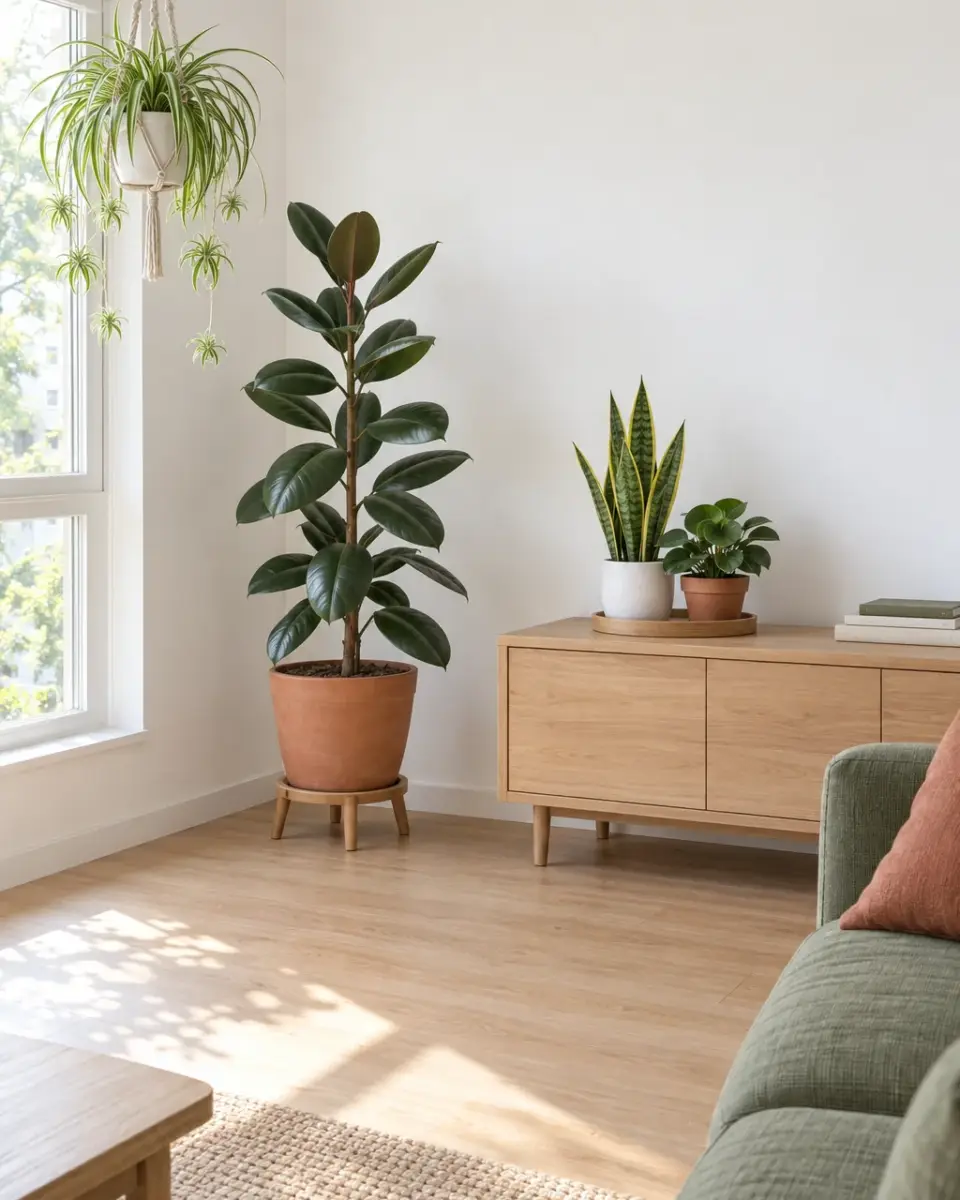
The floor is for plants with real presence. In a medium-light spot a few feet from an east or west window, a rubber plant (Ficus elastica) gives you height and big, glossy leaves. In a dim corner, a tall snake plant (Dracaena trifasciata) or a ZZ plant (Zamioculcas zamiifolia) handles the low light that would make most floor plants stretch.
Scale is where floor plants go wrong. Next to a sofa, a floor plant should rise clearly above the armrest, ideally near the backrest, or it gets lost among the furniture legs. Set the pot on a cork mat or a low wooden plant stool to protect the floor and lift the plant a few inches. Terracotta and matte ceramic both look calm against white walls and light wood.
Tabletops: small groups with a clear outline
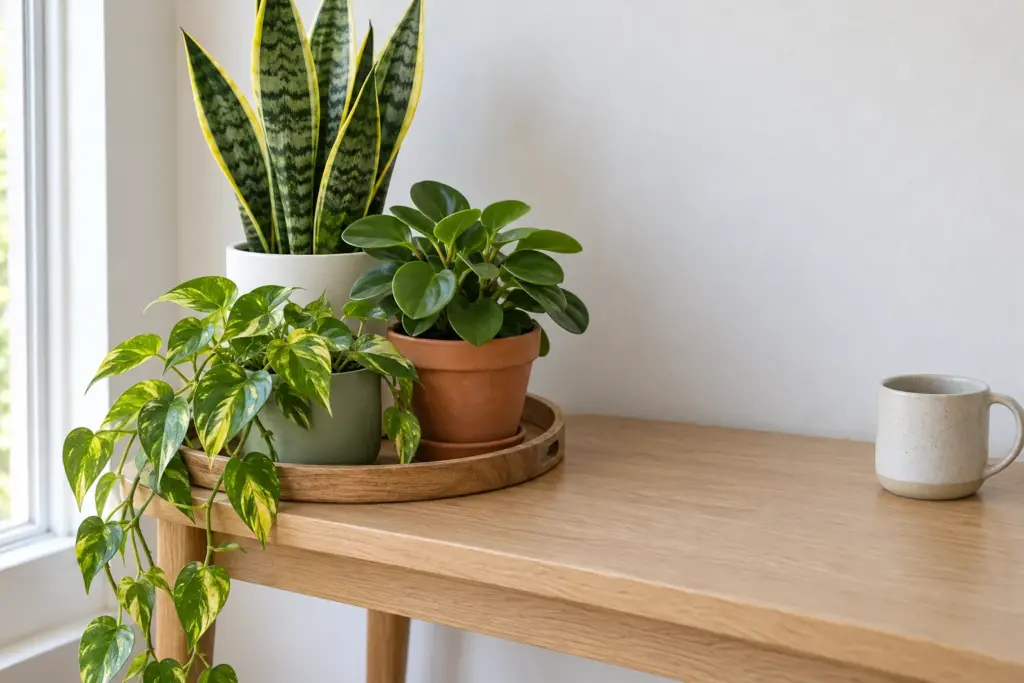
A single small pot on a big console looks accidental, and five pots spread across it look like storage. Group tabletop plants on a tray instead. The tray draws a border around the group, catches drips and lets you move everything at once when you clean.
Designers often group in odd numbers, and on a small surface three plants usually look more relaxed than a pair. Vary the shapes, not just the sizes: an upright plant such as a small snake plant, a rounded peperomia, and a pothos trailing over the edge. Keep one group per table, at one end, so there’s still room for a lamp or a mug.
Grouping has a small practical bonus. Plants release moisture through their leaves, and a cluster creates a slightly more humid pocket around itself, Nebraska Extension notes. Just make sure everything on the tray wants the same light.
Shelves: plants, objects and empty space
Shelves fill up fastest, so leave part of each one empty. A shelf that mixes two or three plants with a few books, a bowl or a small framed print looks styled. A shelf packed edge to edge with pots looks like a garden center bench.
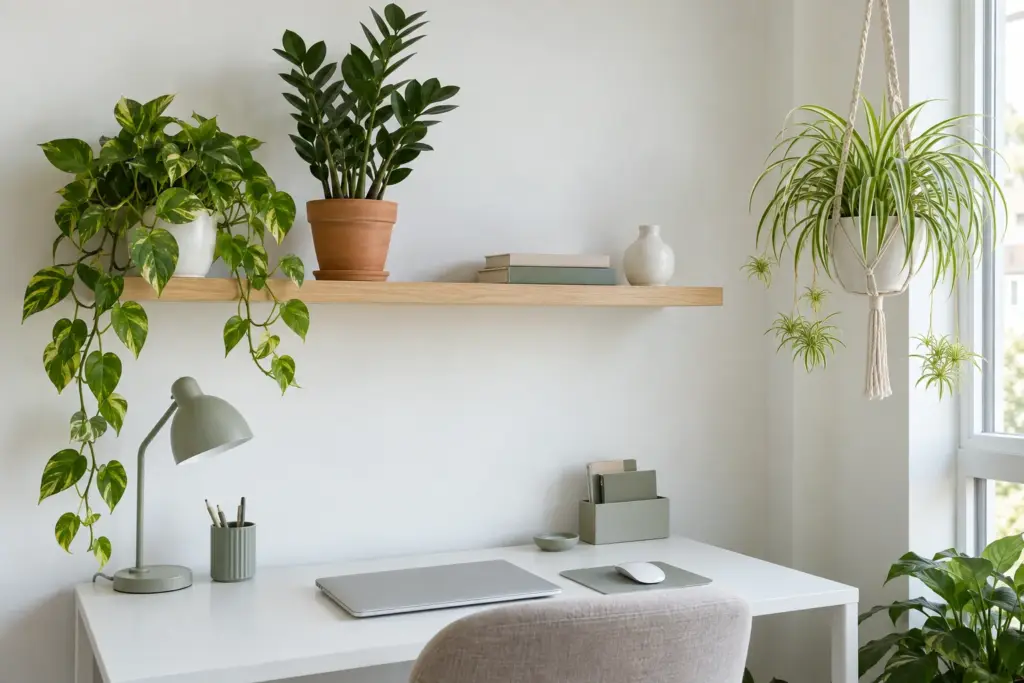
Put trailing plants at the ends or on the top shelf so the vines fall clear of everything below. Pothos is the classic choice and copes with low light, which matters because shelves often sit on the wall opposite the window. For bracket styles and layouts, browse these shelf arrangements for a wall of plants. If your only free wall is dim, adding a small grow light above one shelf can make it workable.
Hanging planters: the empty air above
Hanging plants free up floor and table space. Purdue Extension suggests hanging planters when windowsill space runs short, and near a window is where they’ll get the light they need. Keep them out of walkways, but low enough to reach the soil with a watering can.
A spider plant (Chlorophytum comosum) handles medium light and sends out dangling plantlets that look good from below. Pothos works in dimmer spots. Wet soil in a ceramic pot is heavy, so screw the hook into a ceiling joist or a wall stud rather than bare drywall. For more options, see these trailing plants that suit a ceiling hook.
Keeping the arrangement balanced instead of busy
Match plant size to the furniture beside it
A tiny succulent next to a tall bookcase disappears, while a tall floor plant balances a low console. When a plant feels lost, change its height with a stand, a shelf or a hook before adding another plant beside it.
Repeat pots and colors across the room
Pot choice calms a display more than the plants do. Pick a short palette, for instance terracotta and white ceramic with a touch of rattan or wood, and repeat it on every level. When the floor pot, the tray group and the hanging planter share a material or color, the room reads as one collection.
Leave breathing room on purpose
Gaps are part of the display. Leave visible wall between the anchor plant and the shelf, and keep at least one surface in each room completely clear. If a plant struggles in the spot that looks best, move it to better light rather than filling the gap with a new one.
Care notes that keep a plant display tidy
- Group by needs, not just looks. Put plants with the same light and watering habits together, so one watering routine covers the whole group.
- Hide the nursery pot. Decorative pots without a drainage hole work as outer sleeves. Penn State Extension recommends keeping the plant in a pot with drainage inside the decorative one, with space underneath for water to collect. Empty any water left standing after you water.
- Check hanging plants more often. Warm air rises, so pots near the ceiling dry out faster than those on the floor, according to Oklahoma State.
- Avoid vents and drafts. Keep plants away from heating vents and drafty doors, which both stress foliage.
- Think about pets at every level. Pothos is toxic to cats and dogs on the ASPCA toxic and non-toxic plant list, and a vine trailing from a shelf or a hanging pot can dangle within reach. Spider plants are listed as non-toxic there, and the American Animal Hospital Association also names parlor palms and peperomias as non-toxic to cats and dogs.
Plant display questions about spacing, matching pots and small rooms
How many plants is too many for one room?
There’s no fixed number. The warning signs are practical: you can’t reach a plant to water it, pots block a surface you use daily, or plants slowly stretch and drop leaves. Edit or move plants before adding new ones.
Should all the pots in a room match?
They don’t need to match, but they should relate. Two or three materials or colors repeated across the room look intentional, while ten different styles look random.
Is there a simple rule for how to display plants indoors in a small apartment?
Use vertical space before horizontal space. One floor plant, one tabletop group, a shelf with open space and one or two hanging planters usually look calmer than a dozen pots spread across the floor and windowsills. Keep the floor as clear as possible.
Can a plant live on top of a bookcase far from the window?
Only a low-light plant, and even then growth will be slow. Pothos and ZZ plants are the safest bets. If you add a grow light, UMN Extension suggests keeping foliage plants about 12 to 24 inches below it for 12 to 14 hours a day. Check the soil before watering, since plants in low light use less water.
Quick recap: how to display plants indoors with less clutter
- Map the bright, medium and dim zones before buying or moving a single pot.
- Choose plants that suit each zone’s real light.
- Give each wall one anchor plant and keep the rest smaller.
- Group tabletop plants on a tray, one group per surface.
- Leave empty space on shelves and put trailing plants at the ends.
- Hang plants near windows from a joist or stud, and check their soil more often.
- Repeat two or three pot materials across the room.
Start with one room: move every plant into its light zone, then take one pot off the busiest surface and see how the space feels. Stuck on a tricky corner or shelf? Send your question through the Contact page.