That empty corner next to the sofa looks like the natural home for a plant. It’s also, very often, the spot in the room that gets the least light. Plenty of plant corner ideas skip that detail, which is how a tree that looked perfect in a photo starts dropping leaves a few weeks after it moves in.
So read the corner first, then choose the plants, the stand and the pots. Below are ideas for bright window corners, medium-light living room corners, dim corners and tight apartment corners, each with plants that can actually live there.
Plant corner ideas start with how much light reaches the corner
A corner usually sits farther from the glass than anywhere else in the room, and indoor light fades fast with distance. Nebraska Extension’s guide to houseplant light puts the brightest spot in most homes at a south window and the darkest across the room from a north window, with east and west windows giving about 60 percent of a south window’s light and north windows about 20 percent.
So note which way the nearest window faces, measure the distance to the corner in feet, and use these rough zones, which match common grower guidance:
| Distance from the window | Typical light | Corner plants that fit |
|---|---|---|
| Up to about 2 feet | Bright | Fiddle leaf fig |
| About 3 to 6 feet | Medium | Parlor palm, Kentia palm, golden pothos |
| About 6 to 10 feet | Low | ZZ plant, snake plant, cast iron plant |
A north window pushes every zone down a step, and so can a building or tree outside. Oklahoma State University Extension puts it bluntly: very few plants tolerate dark corners.
Window corner ideas for a tall statement plant
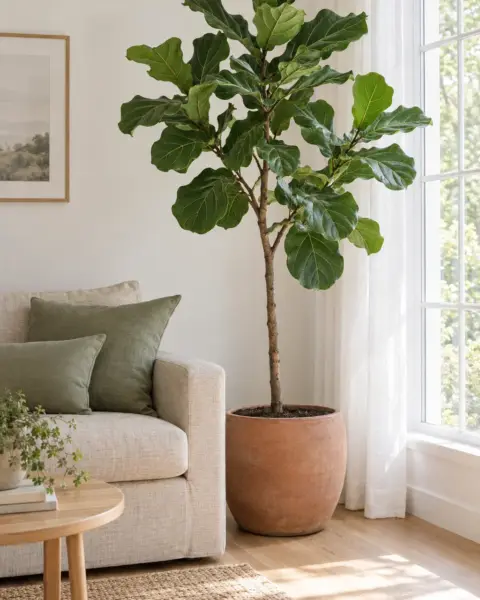
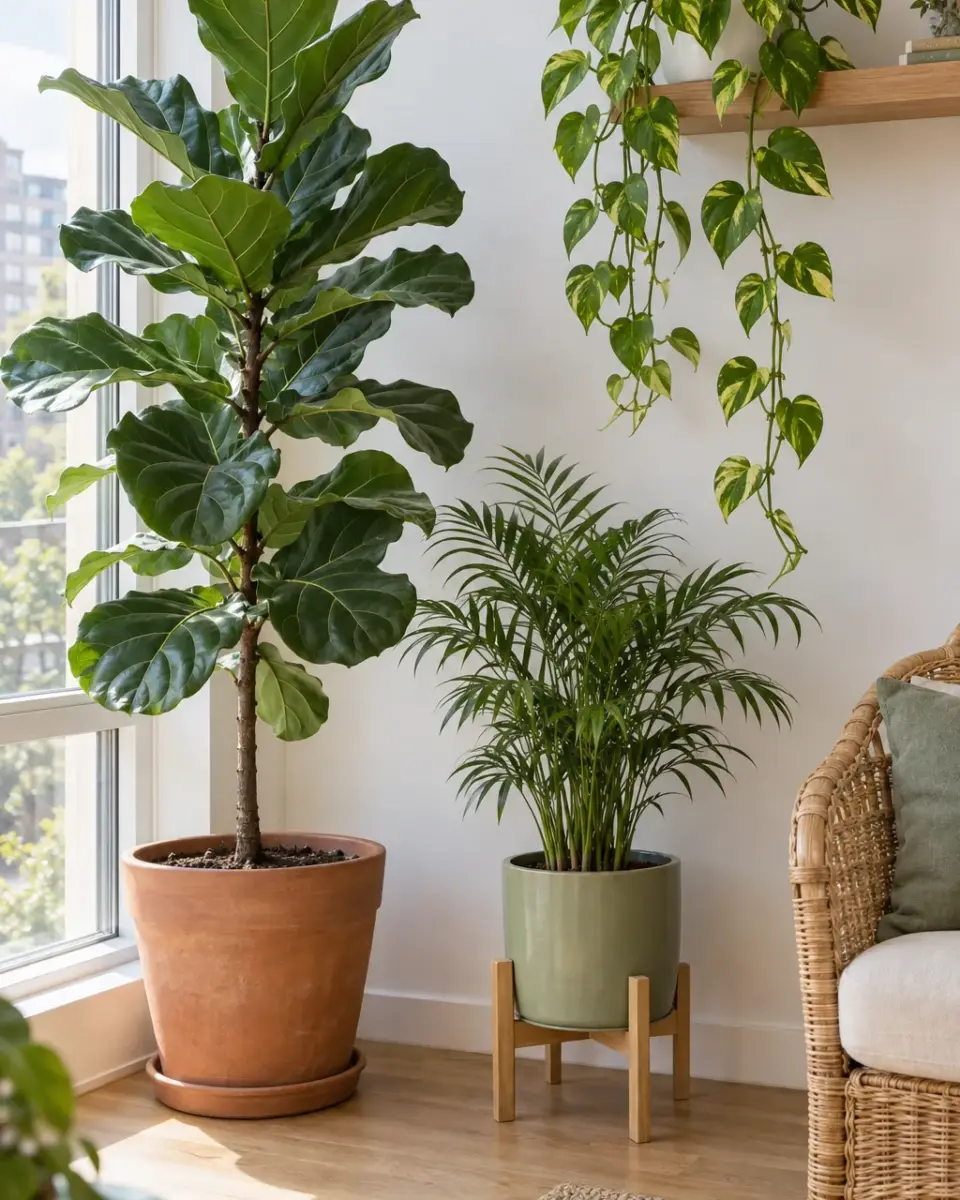
The corner right beside a bright window is the one place where a big, light-hungry tree makes sense. The fiddle leaf fig (Ficus lyrata) is the classic pick. UF/IFAS Extension describes leaves up to 18 inches long on a plant that reaches 2 to 10 feet indoors, and NC State Extension notes it wants bright indirect light with protection from afternoon sun.
- Set it within about 2 feet of an east window, or a few feet back from a south or west window with a sheer curtain.
- Keep the leaves a few inches off the glass, since leaves touching a window can be hurt by winter cold and summer heat.
- Turn the pot a little each time you water, as UF/IFAS suggests, so the tree doesn’t lean. A wheeled plant caddy under a heavy terracotta or ceramic pot makes that easy.
Those violin-shaped leaves already read as one bold shape, so keep the surroundings quiet: a pale wall, a woven basket, a small round side table. The ASPCA lists fiddle leaf fig as mildly toxic to cats and dogs.
Living room corner ideas for medium light
Most living room corners land in the middle zone, roughly 3 to 6 feet from a window with no direct sun on the leaves. That’s palm territory.
A parlor palm or Kentia palm as the anchor
The parlor palm (Chamaedorea elegans) has soft, feathery fronds on thin green stems. Penn State Extension says it usually stays 2 to 3 feet tall as a houseplant, though it can reach 6 feet, and UF/IFAS adds that it tolerates low light. The ASPCA lists it as non-toxic to cats and dogs.
The Kentia palm (Howea forsteriana) has a slender trunk and long arching fronds. Penn State Extension describes it as slow-growing and tolerant of low light, typically 2 to 3 feet tall indoors. Give a Kentia floor space, and put a parlor palm on a stand so its fronds reach the height of the sofa arm instead of hiding behind it.
Add a trailing plant at shelf height
Golden pothos (Epipremnum aureum), with heart-shaped leaves streaked in yellow, softens the hard line where two walls meet. Set it on a floating shelf or bookcase in the corner and let the vines hang. University of Illinois Extension lists pothos among plants for low light areas. The ASPCA lists it as toxic to cats and dogs, so trim vines before they reach pet height.
In a reading corner, slip the palm’s nursery pot into a rattan or seagrass basket and keep fronds clear of the chair back so you don’t brush them every time you sit.
Low-light corner ideas for the far side of the room
If the corner sits 6 feet or more from the window, or near a north window, skip the trees and choose plants built for dim spots.
The ZZ plant (Zamioculcas zamiifolia) carries glossy, almost polished-looking leaflets on thick upright stems. UF/IFAS research found it more tolerant of low light than snake plant or cast iron plant, usually 16 to 32 inches tall, and notes that ZZ plants in 8 or 10 inch pots are best on the floor, even in low-light corners (UF/IFAS guidelines for the ZZ plant). NC State Extension flags it as a problem for cats and dogs.
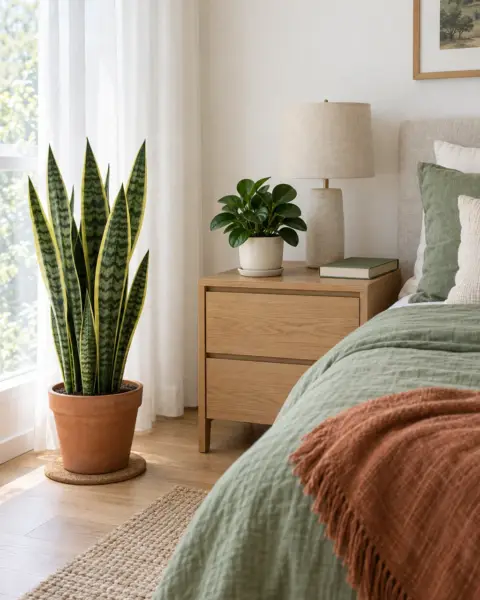
The snake plant (Dracaena trifasciata) has stiff, upright, sword-shaped leaves with banded markings, and its narrow footprint suits a tight spot beside a door. The ASPCA lists it as toxic to dogs and cats.
The cast iron plant (Aspidistra elatior) has broad, dark green leaves that arch up to about 18 inches long, according to Iowa State University Extension, and Penn State Extension says it tolerates neglect and low light. The ASPCA lists it as non-toxic.
Low light still means some light. UF/IFAS notes that a ZZ won’t bloom in low light, and all three grow slowly there. If the corner has no view of a window at all, a lamp is the honest fix, and this guide to picking a plant lamp for a dark spot covers the basics.
Pale pots in matte white or cream stand out against shadow, and pairing two shapes, like the upright snake plant beside the bushy ZZ, keeps a dim corner from looking flat.

Small apartment corner ideas that go vertical
When floor space is tight, use height instead of width.
Tiered corner stands and ladder shelves
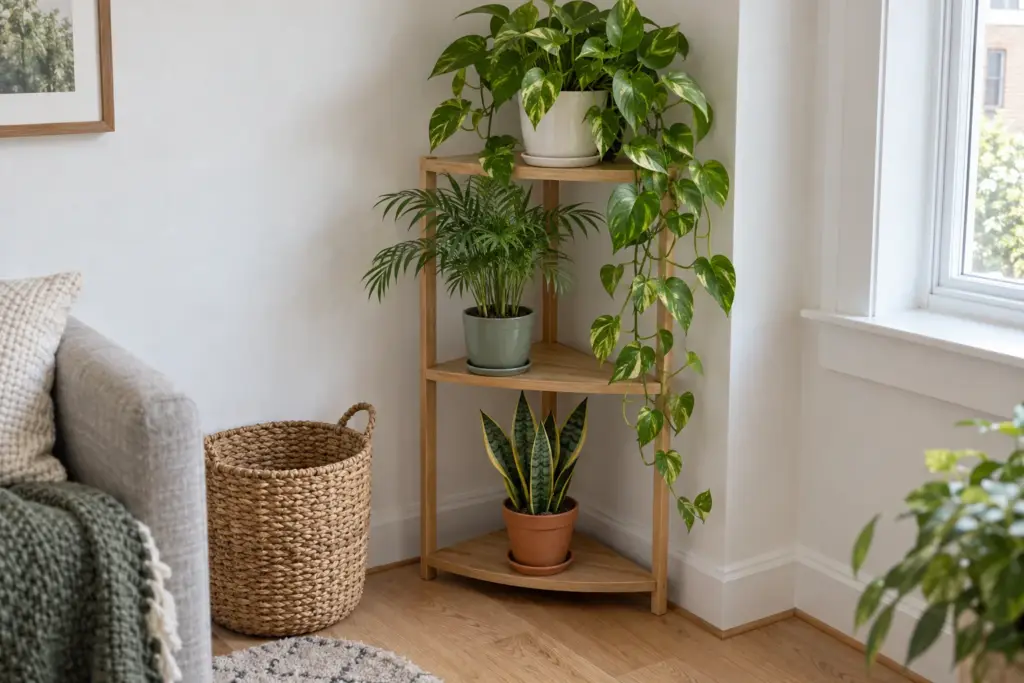
A triangular corner stand or narrow ladder shelf holds three or four plants in the footprint of one. Put the plant that needs the most light on the tier closest to the window and shade-tolerant ones lower or toward the back. Add a saucer under every pot to protect the wood, and pick slim plants: a young snake plant, a small parlor palm, a pothos trailing from the top.
Hanging planters near the window
A pothos in a hanging planter frees the floor entirely. Wet soil is heavier than it looks, so use a ceiling hook rated for the weight and fixed into a joist or proper anchor, with a pot that has a built-in saucer.
How to mix plant heights so the corner looks planned
A corner looks styled when the eye climbs it in steps: a tall anchor on the floor, a medium plant on a stand, then something trailing from above or low and round at the front. Contrast leaf shapes too. The big flat leaves of a fiddle leaf fig, the fine fronds of a palm and the glossy leaflets of a ZZ look richer together than three similar plants.
Repeat one material to tie the group together, like all terracotta, or white ceramic with natural wood stands. Watch scale: a 2-foot palm on the floor beside a tall bookcase looks lost, while the same palm on a stand holds its own. The same layering works beyond corners, as this room-by-room plant styling guide shows.
Group plants with similar light and water needs. Grouping also raises the humidity around them a little, according to the UC Marin Master Gardeners and UW-Madison Extension, which adds that misting is not an effective way to raise humidity.
Care notes that keep a plant corner healthy
- Check for vents first. Corners often hide heating registers or sit near an outside door, and UW-Madison Extension advises keeping plants away from hot air and cold drafts.
- Give each plant a quarter turn every time you water, as University of Illinois Extension recommends, because a corner plant gets light from one side only.
- Water by feel, not by calendar. Plants in dim corners use water more slowly, so check the top inch or two of soil first.
FAQ: plant corner questions about light, stands and pets
Can a plant live in a corner with no window nearby?
Not for long without help. Even ZZ, snake plant and cast iron plant need some daylight, so add a lamp designed for plants or choose a spot closer to the glass.
What are easy plant corner ideas for a small living room?
Start with one floor plant matched to the corner’s light, then build up with a tiered stand or shelf instead of more pots on the floor. A parlor palm on a stand with a pothos trailing from a shelf above suits most medium-light corners.
How high should a plant stand be in a corner?
High enough to do a job. Near a window, a stand lifts a smaller plant into brighter light; elsewhere, bring the leaves up to the height of nearby furniture, like a sofa arm, so the plant isn’t hidden.
Which corner plants are safe for cats and dogs?
The ASPCA toxic and non-toxic plant list includes parlor palm and cast iron plant as non-toxic to cats and dogs. Snake plant and golden pothos are listed as toxic and fiddle leaf fig as mildly toxic, so keep those out of reach or skip them.
Quick recap: plant corner ideas to start with
- Measure the corner’s distance from the nearest window and note which way it faces.
- Within about 2 feet of a bright window, try a fiddle leaf fig, turned regularly.
- In a medium corner, anchor with a parlor or Kentia palm and add a trailing pothos up high.
- In a dim corner, choose ZZ, snake plant or cast iron plant, plus a plant lamp if there’s no window view.
- In a small apartment, go vertical, light-hungry plants closest to the window.
- Layer three heights and repeat one pot material.
Have a corner that doesn’t fit any of these plant corner ideas? Describe its light and size through the Contact page.